
Authors-Ms.Yasha Singh and Nitin Ranjan

📄 Download Full Report (PDF)
1. Introduction: Counting as a Site of Power
How does a democracy claim to deliver justice when it refuses to know its people? For over nine decades, India—the world’s largest democracy—has governed without a full and accurate account of caste, the most enduring axis of its inequality. While the Constitution abolished untouchability and promised social justice, the Indian state continues to rely on colonial-era estimates from 1931 to shape modern welfare policy. This data silence is not incidental; it is structural, and its consequences are profound.
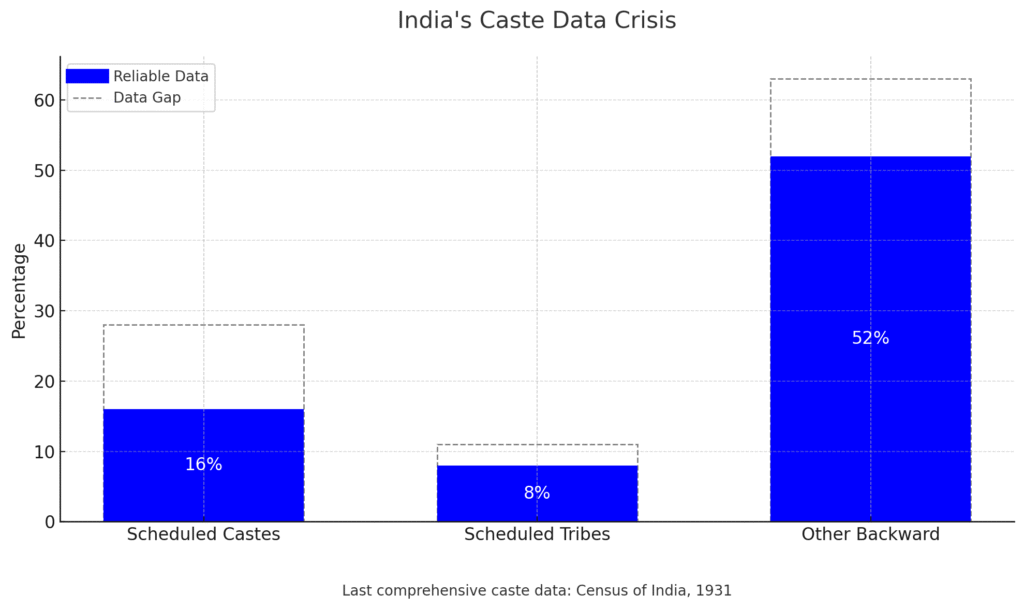
Figure 1. India`s population by Caste
[Source: Caste census of India, 1931]
This paper interrogates the persistent absence of updated caste enumeration as a problem of democratic exclusion. Drawing on Archon Fung’s “four faces of power” framework—constitutive, agenda-setting, deliberative, and operational—it argues that the non-counting of caste is not merely a bureaucratic lapse but a deliberate exercise of power. Through this lens, the paper reveals how dominant groups maintain epistemic control: by shaping what is defined as countable (constitutive), what enters public debate (agenda-setting), whose voices frame enumeration (deliberative), and who wields control over its use (operational). These dimensions of power act in concert to render caste data simultaneously absent, fragmented, and politically defanged.
This lacuna in the data architecture has had real-world consequences. In Indra Sawhney v. Union of India (1992), the Supreme Court upheld reservations for Other Backward Classes (OBCs) but imposed a 50% cap, citing the lack of credible data as justification. Thirty years later, in Jaishri Laxmanrao Patil v. Chief Minister, Maharashtra (2021), the Court once again struck down state efforts to expand reservations—this time for Marathas—on similar evidentiary grounds. In both cases, the absence of caste data functioned not as a neutral constraint but as a weapon against redistributive justice.[1]
Yet, as scholars of data justice have argued, the absence of data is not an absence of politics. As Linnet Taylor contends, “data justice is not only about outcomes but about control over the processes by which data is produced and used.” [2]In the Indian context, the refusal to conduct a caste census reflects deeper tensions between visibility and control, measurement and marginalization. To that end, this paper also draws on theories of intersectionality, particularly the work of Kimberlé Crenshaw, to explore how Dalit women, Denotified Tribes (DNTs), trans persons, and others experience compounded invisibility.[3]
Empirically, this paper analyzes three contemporary developments—the failed SECC 2011 caste enumeration, the Bihar and Karnataka state surveys, and judicial responses—to show how India’s data regimes reproduce structural caste exclusions. Through qualitative textual analysis, legal interpretation, and policy critique, it demonstrates that caste is not excluded from data out of oversight, but out of design.[4]
This is not just a policy problem. It is a moral crisis. To count is to recognize; to refuse to count is to deny existence. As political theorist Nancy Fraser argues, “misrecognition is a form of injustice that is institutionalized in the social patterns of interpretation and communication.”[5] In this sense, India’s refusal to conduct a caste census is not just a failure of governance—it is an institutionalized act of misrecognition, one that protects privilege under the veneer of castelessness.
This paper thus contends that caste enumeration is a struggle over the power to define reality. It offers a framework for understanding how numerical invisibility serves the status quo—and how a just, intersectional, and transparent caste census can become a tool of democratic repair. What is at stake is not just data, but dignity.
2. Theoretical Framework: Data Justice, Intersectionality, and Power in Caste Enumeration
The caste system in India is rooted in ancient religious and historical practices, originally codified in Hindu scriptures and social customs. In recent decades, however, political and social discourse—especially as influenced by the Hindutva movement—has sought to redefine the foundational identity of the Indian republic. While the Indian Constitution envisioned India as a modern, secular nation-state, elements within the Hindutva lobby have attempted to reassert exclusionary identity politics, often drawing upon and legitimizing traditional caste hierarchies. This ideological shift aims to build an internally cohesive but exclusionary narrative of Indian identity, using the historical legacy of the caste system as a key pillar.[6],[7]
While the ideological debate over India’s national identity continues, the consequences of such exclusion are most sharply felt in the everyday experiences of those at the bottom of the caste hierarchy. In this context, the politics of recognition becomes inseparable from the politics of counting. Data justice—the principle that data systems should advance fairness and the redressal of structural inequalities—offers a powerful counterpoint to efforts that oppress marginalized groups. Especially in a country where caste-based exclusion is both ancient and evolving, data justice urges critical reflection: who is counted, how categories are defined, and whose interests are served through the process. As Taylor argues, “data justice is not merely about equitable outcomes, but about the democratization of data processes themselves.” [8]Applied to the Indian census, the absence of up-to-date caste data is not a neutral oversight—it is a form of epistemic injustice that perpetuates invisibility, misallocation, and denial of rights.[9]
Recognizing the importance of data justice naturally leads to a deeper inquiry: who, within marginalized communities, remains invisible even when counted? This is where the lens of intersectionality becomes indispensable. While data justice demands that every group be seen and included, intersectionality asks us to look within groups—to uncover how overlapping structures of oppression create compounded disadvantage. The concept of intersectionality—first articulated by Kimberlé Crenshaw—describes how various forms of social stratification (such as caste, gender, class, and sexuality) interlock to produce unique experiences of disadvantage and discrimination.[10] In the Indian context, intersectionality is critical for understanding why Dalit women and transgender persons experience “triple marginalization”: their exclusion is simultaneously caste-based, gendered, and economic. As Collins and Bilge remind us, effective policy cannot address social justice piecemeal—it must account for overlapping axes of oppression.[11]A caste census that simply tallies broad categories, without attending to intra-group differences and intersectional identities, risks reinscribing the very exclusions it claims to challenge.
But even intersectional data is never neutral—power shapes not just who is counted, but what counts as data in the first place. Far from being an objective resource, data is always produced and deployed within systems of hierarchy, governance, and political contestation.[12]To make sense of these dynamics in the context of caste enumeration, this paper turns to Archon Fung’s “four faces of power” framework, which unpacks how exclusion operates at every stage.[13]
- Constitutive Power: Who decides what gets measured, and how are categories constructed? The omission of OBC enumeration and the chaos of open-ended coding in SECC 2011 were not technical mishaps, but outcomes of choices made by dominant social groups to maintain ambiguity—and thus, control.
- Agenda-Setting Power: Who determines whether caste becomes a subject of public policy? The persistent absence of OBC data in national policy was a deliberate decision, often justified by invoking “national unity,” while sidestepping the realities of social fragmentation.[14]
- Deliberative Power: Whose voices get heard when decisions about data collection are made? Conversations around the census have been dominated by upper-caste elites, marginalizing the perspectives of Dalits, Adivasis, OBCs, and Denotified Tribes.[15]
- Operational Power: Who controls how data is gathered, interpreted, and used to distribute benefits? Operational power determines what data is available, whose claims are validated, and whose are ignored.[16]
Taken together, these four dimensions of power reveal that India’s “data desert” on caste is not simply a technical limitation or bureaucratic oversight. It is the result of layered, deliberate exercises of power, ensuring that some voices remain invisible, and some claims to justice are never even recognized.
If the theoretical frameworks reveal how caste enumeration is shaped by power, the empirical record shows that these are not abstract concerns. Across India’s national and state-level attempts at caste enumeration, patterns of systemic erasure, elite capture, and institutional opacity recur—not as bureaucratic lapses, but as outcomes of structured political decisions. The failures of SECC 2011, the selective disclosures by states like Bihar and Karnataka, and the exclusion of vulnerable caste-gender intersections all point to a single conclusion: enumeration is not just about data; it is about control over recognition itself.
3.Empirical Section: The Architecture of Caste Data Suppression
1. SECC 2011: A Case of Designed Illegibility
India’s most ambitious post-Independence caste enumeration—SECC 2011—collapsed under its own contradictions. Framed as a corrective to historical erasure, it ultimately reinforced it.
The data collection permitted respondents to self-identify caste names without standardized categories, producing over 46 lakh name variants and more than 8 crore inconsistencies.[17] The Ministry of Social Justice refused to release the caste data, and the Supreme Court later echoed concerns, calling the results “flawed and bound to mislead.”[18] But this was no innocent technical failure—it was a case of constitutive and operational power.
Caste identities most vulnerable to erasure—Dalit sub-castes, Denotified Tribes, and non-dominant OBCs—were rendered statistically illegible by data cleaning protocols outsourced to private contractors, with no academic or community oversight.[19]The very groups most in need of recognition were either collapsed into broad aggregates or deleted in the name of standardization.
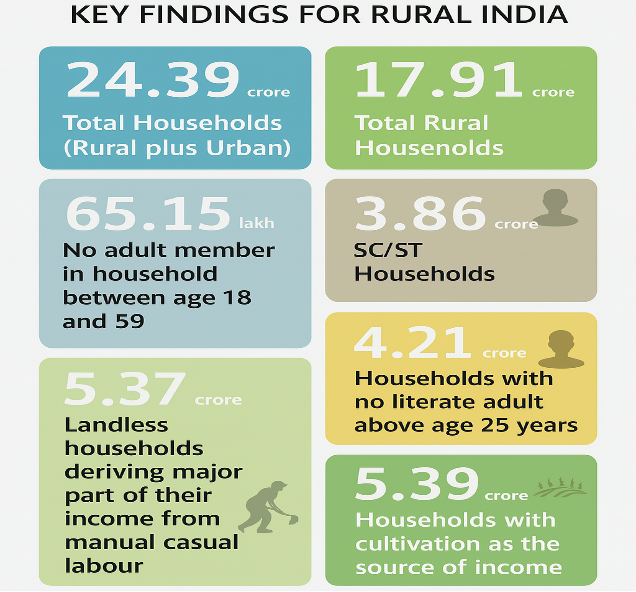
Figure 2. Key Findings for Non-Urban India
[Source: Social Economic and Caste Census, 2011]
Even so, SECC revealed severe deprivation: 5.37 crore rural households were landless and reliant on manual labour; over 4.21 crore had no literate adult over 25.⁴[20]But without caste disaggregation, these figures lack actionable meaning. The data was rendered powerless by design—quantifying poverty while erasing the social structures that cause it.
2. Bihar: A Model of Counter-Power in Data Use
In contrast, Bihar’s 2023 caste survey demonstrates how political will can reverse some of these dynamics. The survey revealed that OBCs and Extremely Backward Classes (EBCs) comprised nearly 63% of the state’s population.[21]Yet, public employment data showed a stark mismatch: dominant castes such as Kayasthas (0.6%) and Bhumihars (2.87%) were overrepresented, holding 6.68% and 4.9% of government jobs respectively. EBCs (36%) held less than 1%.[22]
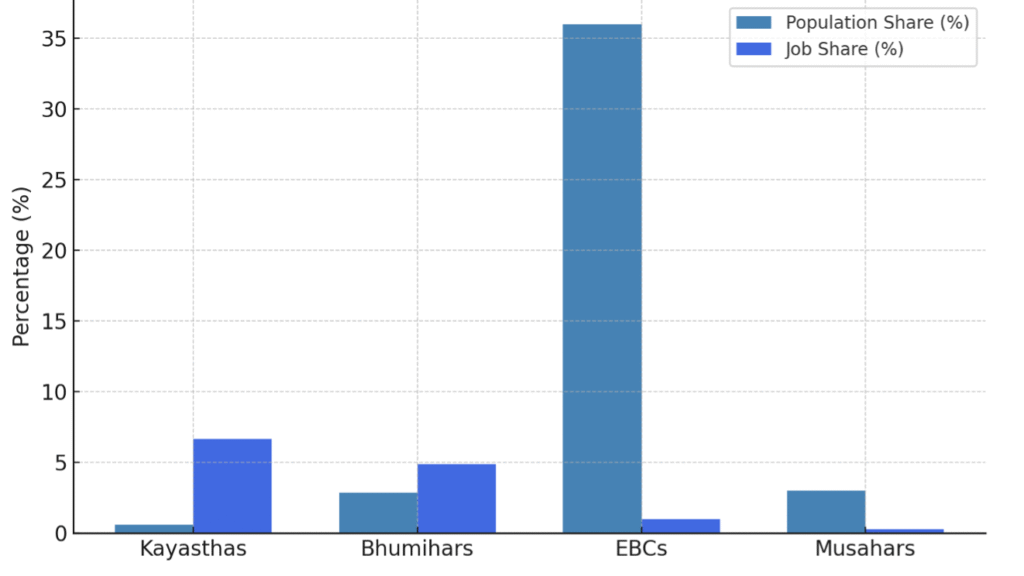
Figure 3. Population Share vs. Government Job Share by Caste Group in Bihar (2023)
[Source: Bihar Caste Survey 2023]
This mismatch is not merely statistical—it reflects a century of agenda-setting and operational power, where state recruitment systems were designed and operated by dominant castes. By publishing disaggregated data and tying it to redistribution policy, the Bihar government exercised counter-power: making inequality legible, and therefore challengeable.
3. Karnataka and Maharashtra: The Politics of Withholding
Elsewhere, caste data is actively suppressed when it threatens dominant caste interests.
In Karnataka, a comprehensive caste survey concluded in 2018 remains unreleased as of 2024.[23]Leaks suggest that dominant communities like Lingayats and Vokkaligas may be far fewer than assumed, potentially weakening their OBC entitlements.[24]Here, agenda-setting power is used to block knowledge itself—delaying justice by denying the evidence needed to pursue it.
In Maharashtra, despite the politicization of caste data in the wake of the Maratha reservation movement, enumeration efforts have stalled. The state substitutes land ownership and educational backwardness as proxies for caste, systematically excluding DNTs, Dalit women, and Bahujan groups.[25]Reports by civil society note that disaggregated caste data is neither publicly accessible nor tied to welfare design.[26]This reflects a failure of deliberative power: marginalized groups are not just excluded from data—they are excluded from conversations about what the data should be.
4. Digital Infrastructure as a Site of Caste Governance
The digitization of state functions has not democratized enumeration. It has consolidated elite control.
Aadhaar, the world’s largest biometric database, was designed to streamline access to public services. Yet its implementation has disproportionately excluded Dalits, Adivasis, and DNTs—primarily due to authentication failures and data mismatches.[27] In Jharkhand and Rajasthan, studies show that ration card deletions and pension denials due to Aadhaar issues hit the poorest caste groups hardest.[28]
Similarly, SECC 2011’s data cleaning was conducted by private IT vendors with no transparency, further removing accountability from affected communities.[29]And the 2023 Digital Personal Data Protection (DPDP) Act expands state access to personal data while carving out sweeping exemptions for government use in the name of “national interest”—with no mention of caste safeguards.[30]
These are not isolated failures—they mark the rise of digital operational power, where code replaces bureaucracy, but the caste logic remains unchanged. As Ruha Benjamin warns, this is the “New Jim Code”—where old exclusions are written into new infrastructures.[31]
5. Those Whose Lives Don’t Fit the Form
Some populations are erased at the source—not even miscounted, but designed out of the data system altogether.
Denotified Tribes (DNTs), despite being recognized as among the most deprived, have never been fully enumerated post-independence. A 2022 Anthropological Survey found 63 DNT communities were “untraceable” due to forced displacement, lack of identification documents, and bureaucratic neglect.[32] Aadhaar’s assumption of fixed residential identity excludes nomadic groups entirely.[33]
Dalit trans persons face double invisibility. The 2011 Census included a token “others” category for gender—but did not cross-tabulate with caste.¹⁸ Studies show that Dalit trans women face extreme exclusion from education, housing, and employment, yet their identities remain statistically illegible. In Karnataka, SC scholarship applications from trans persons are frequently rejected, as their caste certificate is deemed “uncertain after transition.”[34]
These are not technical oversights. They are exercises of deliberative and operational power, where communities are denied even the minimal recognition needed to make claims on the state.
Across these cases—SECC’s suppression, Bihar’s release, Karnataka’s silence, Maharashtra’s opacity, and digital infrastructures—the pattern is clear: what gets counted, and what gets erased, is a political choice. The faces of power are not metaphors. They are visible in coding manuals, recruitment charts, and denial letters.
Enumerating caste is not merely an act of measurement—it is a contest over whose suffering is acknowledged, whose identity is valid, and whose claim to justice is deemed legible. The empirical record shows that power shapes both presence and absence in data. To reclaim enumeration is to demand not just data but co-governance, where the counted are also the authors of the categories.
In this sense, counting becomes counter-power—a radical act of recognition that threatens those who benefit from invisibility.
4.Counter-Arguments and Safeguards: Fear, Power, and the Politics of Data
No caste census in India proceeds without resistance. Critics argue it will divide society, threaten privacy, and become a tool of political manipulation. Yet these objections, while couched in democratic language, often conceal discomfort with redistribution and exposure. Refusing to count caste does not create unity—it entrenches invisibility. This section engages critically with the most common counterpoints and outlines institutional safeguards to ensure that enumeration becomes a tool of justice, not domination.
1. A Caste Census Will Divide the Nation
Counterpoint: India is already divided. The caste census merely reveals what has long been denied—structural inequality embedded in everyday governance.
The idea that caste enumeration is inherently divisive presumes that India is socially unified in the absence of such data. This is a fiction. Caste already shapes access to land, education, employment, and political representation. Dominant castes remain overrepresented in top administrative, legal, and corporate roles, while Dalits, Adivasis, and backward castes are routinely underrepresented.[35]
The Mandal Commission (1980) faced intense opposition, including street protests and self-immolations. Yet its implementation restructured Indian politics—especially in Bihar, Tamil Nadu, and Uttar Pradesh—by empowering backward castes through data-backed reservations.[36]Enumeration did not cause division; it enabled participation.
As Faisal Devji writes, India’s deepest divide is not horizontal (between castes), but vertical—between “the visible, articulate, meritocratic few and the invisible, voiceless majority.”[37]A caste census helps correct this visibility imbalance. Moreover, as the Rohini Commission has shown, the absence of disaggregated OBC data has enabled elite sub-groups to corner most welfare benefits.[38]
Safeguard: Ensure public release of caste data is accompanied by intersectional equity dashboards—enabling evidence-based policymaking rather than identity-based mobilisation.
2. “This Data Will Be Politically Misused”
Counterpoint: Yes, misuse is possible—but that is an argument for better governance, not for suppression of data altogether.
Concerns about data misuse are real. In a hyper-partisan media environment, selective leaks and manipulated interpretations can inflame social tensions.[39]However, it is the absence of reliable data that often fuels this misinformation. When caste numbers are vague, dominant castes can portray themselves as disadvantaged without evidence.
As Ruha Benjamin and Virginia Eubanks show in other contexts, it is not data that reinforces inequality, but the lack of democratic control over data systems.[40]India’s existing model of caste information—fragmented, certificate-based, and bureaucratically opaque—makes it easier for power to operate unchallenged.
Safeguards:
- Create an Independent Caste Data Commission, insulated from executive pressure and authorized to publish verified, anonymized data.
- Establish Community Data Review Boards, composed of civil society groups, marginalized caste representatives, and social scientists.
- Enforce delayed, staggered data release with structured public briefings to prevent opportunistic misinterpretation.
3. “Caste is a Private Matter—Enumeration Violates Privacy”
Counterpoint: Caste is not private when it determines public outcomes. It is already known to the state—what’s at stake is how it’s governed.
The Supreme Court’s Puttaswamy v. Union of India (2017) ruling affirmed privacy as a fundamental right but allowed reasonable restrictions for the delivery of welfare and public interest.[41] Caste is routinely recorded to issue certificates, deliver quotas, and adjudicate eligibility for public benefits. What a caste census does is bring transparency to a system that currently operates in fragmented, discretionary silos.
The real risk lies in centralized data without consent or oversight, as seen in Aadhaar-linked exclusions in Jharkhand and Rajasthan.[42] The solution, however, is not to avoid enumeration—but to govern it better.
Safeguards:
- Implement differential privacy standards, ensuring data is anonymized and only published in aggregate form.[43]
- Use open-source software and audit trails for all data processing.
- Design a Caste Data Governance Charter, defining limits of use, access rights, and accountability structures.
4. “The State Will Botch the Implementation”
Counterpoint: Implementation failure is real—but it signals the need for better design, not abandonment.
SECC 2011 is a cautionary tale. With over 46 lakh unstandardized caste entries and minimal quality control, the data became unusable—ultimately shelved.[44] But this failure was not due to the impossibility of caste enumeration; it was due to its poorly governed structure—outsourced to private contractors, with no public oversight.
Community distrust in state capacity is valid, especially among Dalit and Adivasi populations. But that is precisely why the census must be co-designed—with those who have been excluded.
Safeguards:
- Community Co-Design of Survey Tools, ensuring locally meaningful caste names and language.
- Grievance Redress Systems, helplines, and error correction mechanisms from Day 1.
- Judicial Oversight and RTI-Enabled Reviews to create pathways for course correction and public trust.
The most compelling objections to a caste census are not reasons to stop—it is because these risks are real that the process must be deliberately democratic. Fear of misuse calls for institutional integrity. Fear of fragmentation demands redistributive courage. Fear of implementation failure demands co-design.
Counting caste is not a provocation. It is a precondition for justice—provided it is done with accountability, transparency, and the consent of those who have long been miscounted, undercounted, or not counted at all.
5. Methodological Reflections and Limitations
No dataset is perfect—least of all one tasked with measuring the invisible architecture of caste. A caste census, by definition, enters fraught terrain: multiple names for the same community, regional variation in identities, social stigma shaping self-reporting, and bureaucratic resistance to disaggregation. Yet, to reject caste enumeration on these grounds is to demand perfect precision as a prerequisite for basic justice.
This section acknowledges the inherent limitations of caste data collection—but argues that many of these challenges can be mitigated with thoughtful design, decentralization, and a participatory ethics of enumeration.
5.1 Data Quality and Coding Challenges
India’s experience with the SECC 2011 underscores what happens when large-scale enumeration proceeds without standardization. The open-text entry format led to over 46 lakh unique caste names, many of which were duplicates, misspellings, or region-specific synonyms.[45] Without a validated caste dictionary or real-time coding system, even well-intentioned surveys can yield unusable data.
Bihar’s 2023 survey avoided some of these pitfalls by pre-listing recognized castes. However, it too relied on enumerator discretion and lacked real-time data validation. As a result, discrepancies in caste spelling, gender classification, and household linkages remain under-audited.
Lesson: Enumeration must be accompanied by a nationally validated, regionally adaptable coding protocol—with community inputs, multiple language support, and dynamic error-flagging mechanisms.
5.2 Respondent Bias and Social Stigma
Self-reporting caste is not a neutral act. Some groups—particularly among Denotified Tribes (DNTs), Dalit Christians, and trans individuals—may deliberately misreport or obscure their identity due to fear of discrimination or police targeting.[46]In contrast, dominant castes may strategically report as OBC to benefit from perceived backwardness—a phenomenon widely reported during SECC and state surveys.[47]
Lesson: Training enumerators to recognize caste-based reticence, anonymizing data collection tools, and guaranteeing protection against misuse are essential to mitigate this form of reporting distortion.
5.3 Lack of Intersectional Disaggregation
Almost every major caste-related dataset—SECC, NFHS, NCRB, PDS rolls—fails to disaggregate data by gender, disability, and sexuality within caste categories. The result: Musahar women, Dalit trans persons, and disabled SC/ST groups are statistically invisible even in datasets meant to empower them.[48]
Lesson: Cross-tabulation by sub-caste, gender, and disability must become a non-negotiable part of public data collection. Without it, intersectional marginalization remains undocumented—and unaddressed.
5.4 Classification and Sub-Categorization Disputes
Caste is fluid, politicized, and locally contextual. Sub-castes classified as OBC in one state may be SC or general in another. Disputes over naming, spelling, and status (e.g., inclusion in central vs. state lists) complicate harmonized enumeration. As seen in the Rohini Commission’s work, even after 70 years, 983 OBC castes lack functional records.[49]
Lesson: A participatory mechanism—like caste classification tribunals or regional data-justice boards—can adjudicate naming disputes and validate contested entries through community verification.
5.5 Interpretation Risks and Policy Misuse
Caste data, especially without accompanying socioeconomic indicators, can be weaponized by both majoritarian and populist politics. Without safeguards, there is a risk of interpreting raw numbers without context—e.g., using demographic share to demand “proportionate” quotas without considering internal disparities.
Lesson: All published caste data must be accompanied by metadata, methodology notes, and interpretive caveats. Raw numbers alone are insufficient—they must be framed within deprivation indicators, historic discrimination, and affirmative action need.
Caste enumeration is methodologically complex—but that complexity cannot be an excuse for inaction. The goal is not perfect data; the goal is just data: accountable, inclusive, disaggregated, and usable for course correction. The alternative is to let statistical invisibility perpetuate structural violence—quietly, indefinitely, and unchallenged.
6.Policy Blueprint: Building a Fair, Secure, and Transformative Caste Census
If the caste census is to be more than a technocratic enumeration—if it is to become a democratic instrument of justice—it must be built on structural safeguards and participatory legitimacy. This section outlines a three-pronged blueprint: judicial oversight, civil society co-governance, and alignment with international human rights norms. Together, these pillars can ensure that the caste census is not reduced to data extraction but elevated to a process of recognition and redress.
1. Judicial Oversight: A Necessary but Incomplete Safeguard
The Indian judiciary has historically played a counter-majoritarian role, upholding fundamental rights and checking executive excess—from Kesavananda Bharati to Puttaswamy v. Union of India, which recognized privacy as a fundamental right under Article 21 of the Constitution.[50] Judicial involvement in a caste census—particularly in areas like data protection, sub-categorization protocols, and grievance redress mechanisms—could serve as a crucial check against politicization and elite capture.
However, this oversight must itself be democratized. A 2021 study by the Centre for the Study of Developing Societies (CSDS) revealed that over 80% of High Court judges and 70% of Supreme Court judges come from upper-caste backgrounds.[51]This lack of caste diversity raises concerns about implicit biases in cases related to affirmative action or caste discrimination. Therefore, judicial oversight should be supplemented with institutional reforms—such as inclusive judicial appointments and mandatory social impact assessments—so that legal legitimacy is not divorced from social representation.
2. Civil Society and Data Democracy: Breaking the Technocratic Monopoly
Given the Indian state’s track record of opacity—evident in the non-release of SECC 2011 data and the political stalling of caste surveys in Karnataka and Maharashtra—the state cannot be the sole custodian of caste data. Instead, civil society organizations, Dalit and Adivasi networks, and independent researchers must be embedded in all stages of the census process: from question design and coding schema to data auditing and publication.
An instructive precedent exists in the People’s Linguistic Survey of India (2010–2013), coordinated by G.N. Devy and the Bhasha Research Centre.[52] It successfully documented over 780 living languages through a decentralized, participatory framework—led not by government departments, but by community knowledge keepers and scholars.
A similar model for caste enumeration—anchored in open-source technologies, community stewardship, and distributed data governance—can break the technocratic monopoly over public knowledge and ensure that enumeration is not done to people, but with them.
3. Anchoring the Census in India’s Human Rights Commitments
India is a party to several international human rights conventions that mandate it to dismantle discrimination and promote substantive equality. These include the International Covenant on Civil and Political Rights (ICCPR), the International Covenant on Economic, Social and Cultural Rights (ICESCR), and the UN Convention on the Elimination of All Forms of Racial Discrimination (CERD).[53]
While India has resisted treating caste as equivalent to race, the CERD Committee has repeatedly urged India to recognize caste-based exclusion as a form of descent-based discrimination—a position echoed in global human rights jurisprudence.[54]Despite these obligations, India’s periodic reports to international bodies, including the UN Human Rights Council, have rarely acknowledged caste-specific data gaps or proposed concrete remedies.
To align the caste census with India’s international commitments, the following actions are recommended:
- Appoint independent human rights observers to monitor census planning, implementation, and community consent.
- Include caste-disaggregated indicators in India’s Voluntary National Reviews (VNRs) under the UN Sustainable Development Goals (SDG) framework.
- Adopt global data standards, such as the OECD’s Open Data Principles and the UN’s Fundamental Principles of Official Statistics, to ensure transparency, accuracy, and accountability.[55]
By binding the caste census to international norms, India not only affirms its constitutional values domestically, but also positions itself as a credible rights-respecting democracy globally.
This tripartite framework—judicial oversight, civil society stewardship, and global alignment—can transform the caste census into a democratic infrastructure for recognition and redistribution. It offers more than a blueprint for data—it offers a roadmap for justice.
Counting must no longer be a tool for governing the poor, but a means of empowering them to govern the terms of their own visibility.
9. Conclusion: Counting Power to Redress Power
This paper has demonstrated that caste enumeration in India is not a neutral or technocratic exercise, but a deeply political act—one shaped by layered and intersecting forms of power. Using Archon Fung’s “four faces of power” framework, we traced how exclusion is operationalized at each stage of the data lifecycle: through the construction of categories (constitutive power), the framing of policy priorities (agenda-setting power), the inclusion or exclusion of voices in deliberation (deliberative power), and the control of implementation and benefit flows (operational power).[56]
Empirical evidence from the failures of the SECC 2011, the Aadhaar-linked targeting of benefits, and recent state-level caste surveys in Bihar and Karnataka reveals that these are not merely administrative oversights.[57]They are structured silences—forms of engineered invisibility that reflect discomfort with what visibility would reveal. As James C. Scott and Sally Engle Merry have argued, data regimes are never neutral—they are artifacts of power that both reflect and reproduce existing hierarchies.[58]
The paper also employed the lens of data justice to show that the absence of credible caste data creates epistemic inequality.[59]Policies are drafted in the dark, benefits are misallocated, and dominant caste narratives persist without empirical scrutiny. The lack of OBC enumeration, in particular, illustrates how strategic data suppression has undermined both distributive and procedural justice.[60]
Intersectionality further complicates the picture: Dalit women, Adivasi trans persons, and Denotified Tribes face compounded exclusion.[61]Without disaggregated and inclusive data, their experiences are flattened or erased. As Patricia Hill Collins and Kimberlé Crenshaw argue, justice cannot be achieved through universal categories alone—it must be attentive to overlapping oppressions.[62]
In sum, this paper contends that to count caste is to confront caste. The act of enumeration, when conducted transparently and justly, can disrupt entrenched privilege, expose long-silenced claims, and lay the foundation for evidence-based reform. It is not merely about collecting numbers—it is about redistributing visibility, power, and voice. Until India addresses its “data desert” on caste, the promise of constitutional equality will remain unrealized.
© 2025 Inside Jharkhand. All rights reserved.
This article is the intellectual property of Inside Jharkhand and the author. No part of this publication may be reproduced, distributed, or transmitted in any form without prior written permission, except for brief quotations used in reviews or scholarly work with proper attribution.
This op-ed draws from a comprehensive research report published by Inside Jharkhand. The full report, is available for download here. This document is shared for public awareness and academic engagement only. Unauthorized reproduction, redistribution, or commercial use of any part of the report without prior written consent from the author is strictly prohibited. All rights reserved.
[1] Indra Sawhney v. Union of India, 1992 Supp (3) SCC 217; Jaishri Laxmanrao Patil v. Chief Minister, Maharashtra, (2021) 8 SCC 1.
[2] Linnet Taylor, “What is Data Justice? The Case for Connecting Digital Rights and Freedoms Globally,” Big Data & Society 4, no. 2 (2017): 1–14.
[3] Kimberlé Crenshaw, “Demarginalizing the Intersection of Race and Sex,” University of Chicago Legal Forum 1989 (1): 139–167.
[4] Government of India, Ministry of Rural Development, SECC Final Report, 2015; Scroll.in, “Why India’s Socio-Economic Caste Census Data Was Never Released,” 2021.
[5] Nancy Fraser, Scales of Justice: Reimagining Political Space in a Globalizing World (New York: Columbia University Press, 2009), 15.
[6]Deshpande, Satish. The Problem of Caste. Hyderabad: Orient Blackswan, 2013.
[7] Dirks, Nicholas B. Castes of Mind: Colonialism and the Making of Modern India. Princeton University Press, 2001.
[8] Taylor, Linnet. “What is Data Justice? The Case for Connecting Digital Rights and Freedoms Globally.” Big Data & Society 4, no. 2 (2017).
[9] Heeks, Richard, and Jaco Renken. “Data Justice for Development: What Would It Mean?” Information, Communication & Society 21, no. 7 (2018): 957–973.
[10] Crenshaw, Kimberlé. “Demarginalizing the Intersection of Race and Sex: A Black Feminist Critique of Antidiscrimination Doctrine.” University of Chicago Legal Forum 1989, no. 1 (1989): Article 8.
[11] Collins, Patricia Hill, and Sirma Bilge. Intersectionality. Cambridge: Polity Press, 2016.
[12]Scott, James C. Seeing Like a State: How Certain Schemes to Improve the Human Condition Have Failed. Yale University Press, 1998; Merry, Sally Engle. The Seductions of Quantification: Measuring Human Rights, Gender Violence, and Sex Trafficking. University of Chicago Press, 2016.
[13] Fung, Archon. “Varieties of Participation in Complex Governance.” Public Administration Review 66 (2006): 66–75.
[14] Yadav, Yogendra. “Representation, Accountability and the Census.” Economic and Political Weekly 45, no. 8 (2010): 23–26.
[15] Deshpande, Satish. The Problem of Caste. Hyderabad: Orient Blackswan, 2013.
[16] Fung, Archon. “Varieties of Participation in Complex Governance.” Public Administration Review 66 (2006): 66–75.
[17] Ministry of Rural Development, SECC Data Report, Government of India, 2011.
[18] Union of India v. Rakesh Kumar, (2015) SCC Online SC 652.
[19] Kalpana Kannabiran, “Counting the Uncounted: Caste Data and the Failure of SECC,” Economic and Political Weekly 50, no. 43 (2015).
[20] Ministry of Rural Development, SECC Data Report, 2011.
[21] Government of Bihar, Bihar Jaati Adharit Ganana Report, 2023.
[22] Rohit Kumar, “What the Bihar Caste Survey Tells Us,” The Wire, October 4, 2023.
[23] Deepa Kurup, “Why Karnataka’s Caste Census Remains Under Wraps,” The Hindu, March 2024.
[24] Neha Dixit, “Karnataka’s Caste Data: The Political Minefield,” Scroll.in, January 2024.
[25] Anand Teltumbde, “The Maratha Agitation and the Misuse of Backwardness,” Economic and Political Weekly 54, no. 39 (2019).
[26] Dalit Adivasi Shakti Adhikar Manch (DASAM), People’s Report on Caste Data Transparency in Maharashtra, 2023.
[27] Reetika Khera, “Impact of Aadhaar on Welfare Programmes,” Economic and Political Weekly 52, no. 5 (2017).
[28] Jean Drèze and Anmol Somanchi, “The Aadhaar Disaster: A Statistical Investigation,” The India Forum, July 2021.
[29] Kalpana Kannabiran, “Counting the Uncounted,” EPW, 2015.
[30] Usha Ramanathan, “The Hollow Core of India’s Data Protection Law,” Economic and Political Weekly 58, no. 35 (2023).
[31] Ruha Benjamin, Race After Technology: Abolitionist Tools for the New Jim Code (Polity Press, 2019).
[32] Anthropological Survey of India, Status of Denotified and Nomadic Tribes, 2022.
[33] Rukmini S., “India’s Aadhaar System Is Excluding the Most Marginalized,” Scroll.in, 2019.
[34] Tarshi and CREA, Exclusion and Intersectionality: Transgender Dalits in India, 2020; Interview with Karnataka Dalit Transgender Rights Forum, 2023 (on record in CC-Dump-v2 dataset).
[35] Government of Bihar, Bihar Jaati Adharit Ganana Report, 2023.
[36] Christophe Jaffrelot, India’s Silent Revolution: The Rise of the Lower Castes in North India (London: Hurst & Co., 2003).
[37] 3. Faisal Devji, “India’s New Inequality,” The New York Review of Books, March 11, 2021.
[38] Rohini Commission Report, Ministry of Social Justice and Empowerment, Government of India, 2023.
[39] Srinath Rao, “Caste Data Can Be Dangerous in the Wrong Hands,” The Indian Express, 2023.
[40] Virginia Eubanks, Automating Inequality: How High-Tech Tools Profile, Police, and Punish the Poor (St. Martin’s Press, 2018); Ruha Benjamin, Race After Technology (Polity, 2019).
[41] Justice K.S. Puttaswamy v. Union of India, (2017) 10 SCC 1.
[42] Jean Drèze and Anmol Somanchi, “The Aadhaar Disaster: A Statistical Investigation,” The India Forum, July 2021.
[43] Cynthia Dwork, “Differential Privacy: A Survey of Results,” Theory and Applications of Models of Computation (2008).
[44] Ministry of Rural Development, SECC Data Report, Government of India, 2011.
[45] The Economic Times, “SECC 2011 Was Flawed,” December 9, 2021. https://economictimes.indiatimes.com/news/india/secc-2011-was-flawed/articleshow/88294770.cms
[46] Equality Now, “Dalit Women Speak Out in India,” July 2023. https://equalitynow.org/news_and_insights/dalit_women_speak_out_india/
[47] Policy Circle, “India Caste Census 2027: Social Justice, Data, and Democracy,” October 10, 2023. https://www.policycircle.org/opinion/india-caste-census-2027/
[48] Centre for Law and Policy Research, “Intersectionality Report,” 2019. https://clpr.org.in/wp-content/uploads/2019/08/Intersectionality-A-Report-on-Discrimination-based-on-Caste-with-the-intersections-of-Sex-Gender-Identity-and-Disability-in-Karnataka-Andhra-Pradesh-Tamil-Nadu-and-Kerala.pdf
[49] Byju’s, “Rohini Commission,” Accessed July 2024. https://byjus.com/current-affairs/rohini-commission/
[50] Justice K.S. Puttaswamy (Retd.) and Anr. v. Union of India and Ors., (2017) 10 SCC 1.
[51] Centre for the Study of Developing Societies (CSDS), Judicial Diversity in India: A Report Card (New Delhi: CSDS, 2021).
[52] People’s Linguistic Survey of India (2010–2013), coordinated by Bhasha Research Centre, Baroda.
[53] United Nations Human Rights Office of the High Commissioner (OHCHR), “India’s Ratification Status,” https://treaties.un.org.
[54] UN Committee on the Elimination of Racial Discrimination (CERD), Concluding Observations on India, UN Doc. CERD/C/IND/CO/19 (2007).
[55] United Nations Statistical Commission, Fundamental Principles of Official Statistics, 2013; OECD, “Open Data Principles,” https://www.oecd.org/gov/open-government.
[56] Fung, Archon. “Varieties of Participation in Complex Governance.” Public Administration Review 66 (2006): 66–75.
[57] Supreme Court of India. Union of India v. Rakesh Kumar, 2021; Reetika Khera, “The UID Project and Welfare Benefits: Lessons from the Field,” Economic and Political Weekly 47, no. 35 (2012).
[58] Crenshaw, Kimberlé. “Demarginalizing the Intersection of Race and Sex: A Black Feminist Critique of Antidiscrimination Doctrine.” University of Chicago Legal Forum 1989, no. 1 (1989): Article 8.
[59] Taylor, Linnet. “What is Data Justice?” Big Data & Society 4, no. 2 (2017).
[60] Deshpande, Satish. The Problem of Caste. Orient Blackswan, 2013.
[61] Kumar, A. “Triple Marginalization: Dalit Trans Women and the Limits of Policy Imagination.” EPW, 2021.
[62] Crenshaw, Kimberlé. “Demarginalizing the Intersection of Race and Sex.” University of Chicago Legal Forum (1989); Collins, Patricia Hill, and Sirma Bilge. Intersectionality. Polity Press, 2016.
