A Comparative Inquiry into Caste in India and Race in the United States
By Yasha Singh and Nitin Ranjan
Executive Summary This report examines the intertwined histories and structures of caste-based oppression in India and race-based discrimination in the United States, drawing legal, cultural, and religious parallels and lessons. Both systems are revealed as deeply entrenched hierarchies enforced through law, social customs, and theology – yet each also carries a legacy of resistance and solidarity.
Section I: Legal Analogies and Lessons compares India’s anti-caste legal framework (e.g. the Scheduled Castes and Scheduled Tribes (Prevention of Atrocities) Act, constitutional abolitions of “untouchability,” and affirmative measures) with U.S. civil rights laws (e.g. the Civil Rights Act of 1964 and anti-lynching efforts). It highlights how a groundbreaking California lawsuit against Cisco Systems in 2020 extended U.S. employment law to caste discrimination[1] and how cities like Seattle have begun explicitly banning caste bias[2]. This section also notes the historical dialogue between these legal systems and international human rights norms that recognize caste discrimination as akin to racial discrimination[3].
The caste system is often narrated as a uniquely South Asian phenomenon. Yet its hereditary status, purity- pollution, and social exclusion has followed the diaspora across continents. From Indian immigrant communities in the U.S. and U.K. to caste–based hiring discrimination in Silicon Valleyand visa marriages in Canada, caste has travelled and adapted.
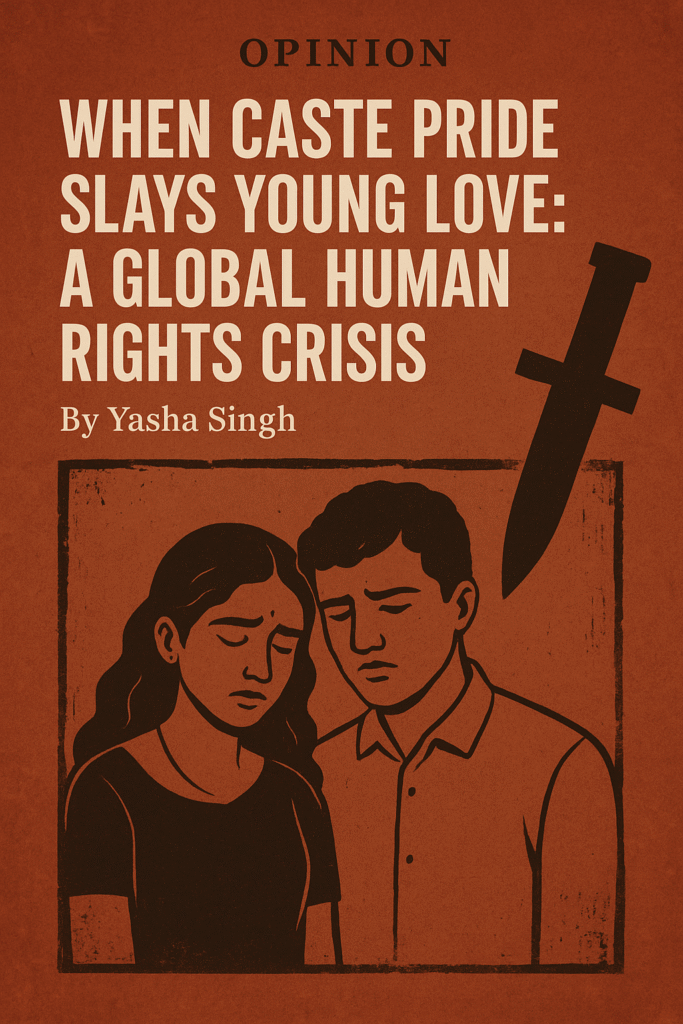
Dr. B.R. Ambedkaronce described caste as “graded inequality.” It mirrors racism in its systemic denial of dignity, autonomy, and freedom. The policing of Dalit love, especially when it crosses caste or class boundaries, is not unlike anti-miscegenation violence once seen in the Jim Crow-era American South. The notion that social groups must not “mix” is enforced through intimate, often familial, violence. Kevin’s death is akin to lynchingswhere Black men were murdered for perceived transgressions against white women.
While caste is often portrayed as a uniquely South Asian issue, the logic of “honour” killings resonates globally. Similar violence occurs in contexts where families suppress inter-religious, inter-ethnic or same-sex unions. The underlying violation is the same: extinguishing individual autonomy in the name of collective reputation. International human rights lawrecognizes this pattern. Therefore even honour-based violence should be considered a hate crime, and it should be recognised that the enforced interference in consensual relationships is a denial of sexual and personal freedom.
For Kevin, the institutions that should have protected him failed. The alleged participation of a police officer in the murder is a grim reminder that caste pride is often shielded by impunity. Justice became hostage to bloodline. But Kevin’s story is not isolated; around the world, romantic and marital violence driven by notions of honour, caste, community, or religion continues unchecked. Therefore , Kevin’s case, and others like it, demand greaterrecognition of the right to love and choose without fear. The UN Human RightsCommitteeand Covenant on Civil and Political Rights (ICCPR)affirm that protections must extend to intimate and marital life. Forced separation, removal of choice, or victimisation on caste grounds breaches these guarantees.
Global human rights actors therefore must include caste-based hate crimes in broader “honour crime” discourse ensuring policies account for caste as a protected category. Non-governmental organizations, academic institutions, and rights-based bodies should use international human rights platforms to spotlight caste killings as a systematic violation of human dignity and equality.
Kevin’s death is a chilling reminder that caste pride is not benign tradition . It is a lethal assertion of hierarchy. Such killings deny basic human rights: freedom, equality, autonomy, and the right to love safely. Recognizing caste based honour crimes as hate crimes under both Indian and international law is a crucial step. Cultural resistance and legal reform must intersect to protect individual choice and dismantle entrenched prejudice.Silences must end on this portable hierarchy. Love must not cost lives.
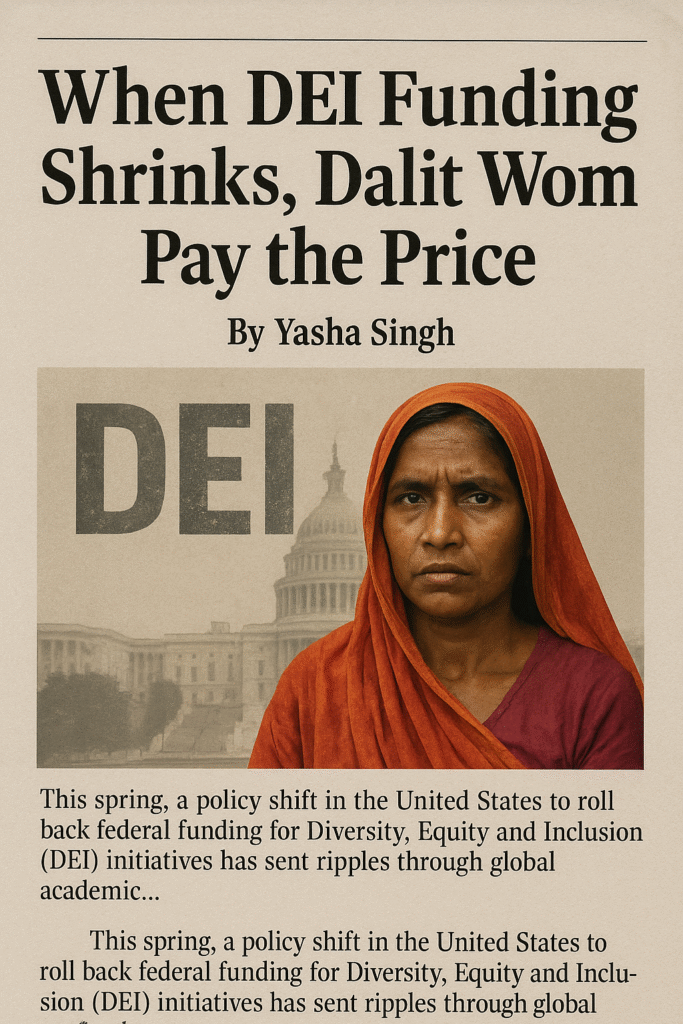
This spring, a policy shift in the United States to roll back federal funding for Diversity, Equity and Inclusion (DEI) initiatives has sent ripples through global academic and human rights communities. While the implications for race and gender equality in the U.S. have rightly drawn attention, what remains less discussed is its global impact.
As a global citizen, I write not just with concern, but with a growing sense of urgency. What may seem like a domestic policy shift in the United States reverberates across oceans, touching the lives of 1.4 billion people in my country, where caste injustice remains a brutal everyday reality. I speak of India’s Dalits – who have been historically silenced and systemically excluded and whose struggles mirror that of Black Americans. They are, in many ways, the unseen siblings of global civil rights movements.
Institutions like Harvard University had taken a lead in bringing the issue of caste equity on global stage .For many of us in India, it felt like the winds of change were beginning to stir. But the rollback of DEI support now threatens to dim our hope , stalling a momentum that had only just begun to reach our shores.
What we need to understand here is that caste is not just a relic of Indian society. It is a global apartheid that persists in invisible forms in employment, education, housing, and even technology. Like race, caste operates through social segregation and inherited disadvantage. And like racism, its heaviest burden falls on women specifically Dalit women, who live at the intersection of caste-based discrimination and patriarchal control. Therefore by taking up the issue of Dalit Atrocity , Harvard University had been doing a service to humanity . So when DEI programs are cut or deprioritized, it is often the most intersectional, least visible communities like Dalits who suffer first. Conversations about caste which are already considered “too niche” or “too local” in many Western circles are likely to be the first casualties. The funding that supports research on caste and gender, that brings Dalit women scholars and activists into global dialogues, that trains institutions to recognize caste dynamics in admissions, hiring and policymaking – that is what’s at stake. Institutions like Harvard have been instrumental in naming and addressing Caste Atrocity . In recent years, they have hosted caste-awareness conferences, expanded curriculum offerings, and fostered inclusive spaces for South Asian students from marginalized backgrounds. Harvard’s stance has also inspired other universities and city governments across the U.S. to begin recognizing caste as a protected category under non-discrimination policies. But these efforts require sustained resources and political will.
In India, Dalit women remain drastically underrepresented in public leadership, routinely subjected to violence, and locked out of economic opportunity. But these inequities do not stop at India’s borders. Caste-based exclusion has followed South Asian communities into the diaspora, including in the United States. Recent lawsuits in American tech companies have revealed caste-based workplace discrimination. Surveys among Indian-American communities show that caste identity remains a source of both privilege and marginalization. Therefore when American institutions scale back their commitment to equity, the signal sent to us in the rest of the world is that justice is negotiable – that some histories matter more than others. For the millions of Dalit women fighting for dignity and recognition, this is not some distant policy question . This is a reminder that their lives are still viewed as marginal even on global platforms that profess inclusion.Therefore the loss of this policy shift is not merely academic. It is personal, generational, and political.
In a time when global movements such as #MeToo, Black Lives Matter, Dalit Lives Matter etc. have reminded us how interconnected injustice is, we cannot afford to turn inward. The social issues of caste, gender, and race have to be understood as interconnected systems of oppression. The moral arc of history may bend toward justice, but it will not do so without institutional support.
As Dr. B.R. Ambedkar, the father of India’s Constitution and a Dalit icon, warned: “Justice is not a natural order. It is a social construct that must be defended.” Today, the defence of that construct lies in our shared commitment to equity across borders .United States has historically given the moral leadership on questions of equality. It must continue to do so , not only for its own citizens, but also for all those who look up to its institutions for inspiration and solidarity. We cannot allow the walls of inclusion to shrink at a moment when they must expand.
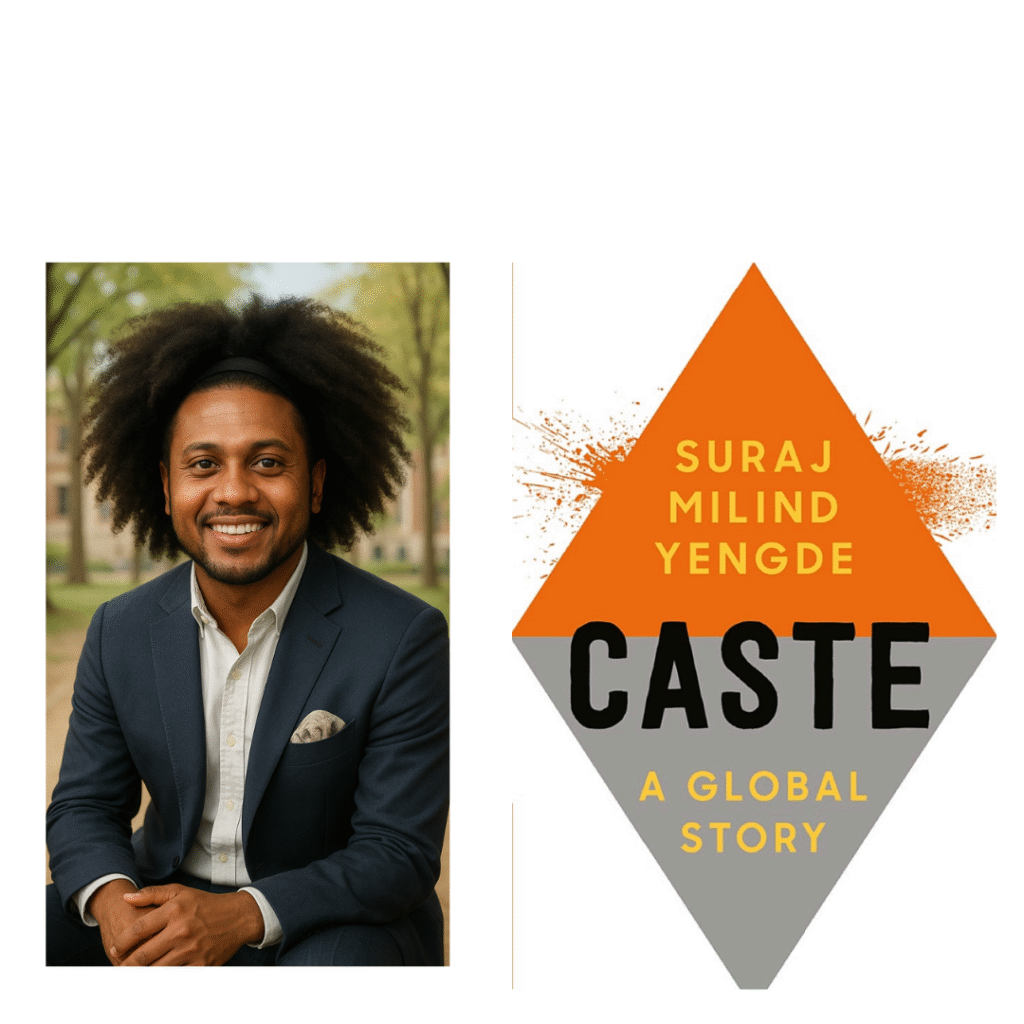
Suraj Yengde’s Caste Matters is not just a book-it is a reckoning. Rooted in personal anguish and political defiance, the text operates as a radical reorientation of how caste is understood, resisted, and narrated. Yengde refuses the comforts of liberal multiculturalism and elite scholarship. He writes not to explain caste but to expose its everyday tyranny through a lens sharpened by rage, sharpened further by method.
As someone engaged in caste justice work on the ground through initiatives like Inside Jharkhand, which documents the lived realities and institutional neglect of Dalit communities , our approach Caste Matters not as an abstract treatise, but as an epistemic companion. Yengde’s anchoring in Charvaka rationalism, in which knowledge flows from lived experience rather than scriptural or statistical authority, directly resonates with the bottom-up methodologies we use in our work: ward-level caste mapping, Panchayat role audits, and counter-enumeration against state invisibilization.
This review does not attempt a neutral summary. Instead, it enters into dialogue with the book-affirming its provocations, extending its arguments, and critically testing them against the realities uncovered through data-driven activism in caste-oppressed geographies. Where Yengde offers testimony as resistance, we bring numbers as insurgency-both confronting a nation that still denies caste even as it thrives on it.
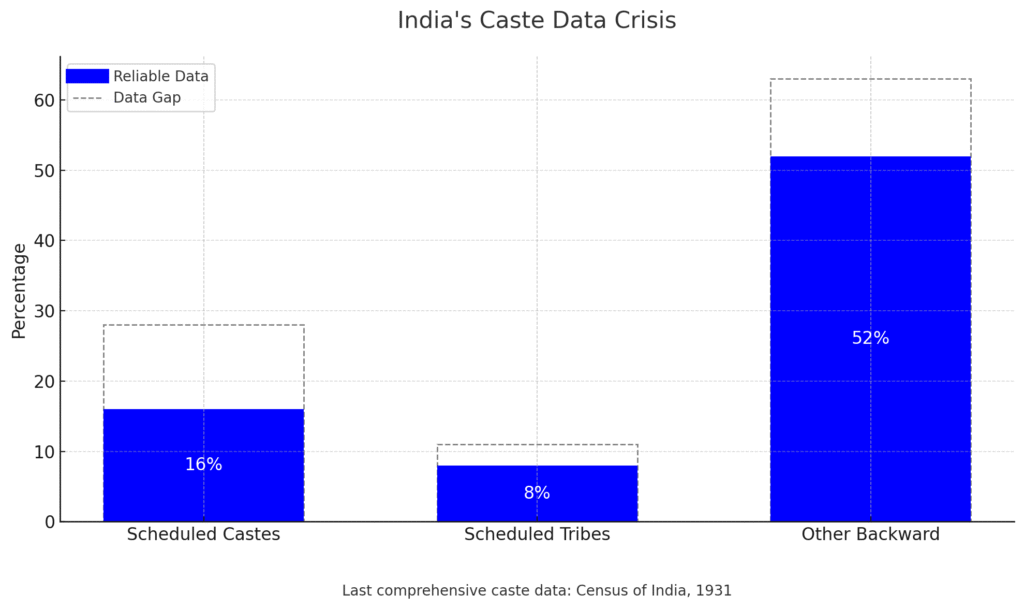
How does a democracy claim to deliver justice when it refuses to know its people? For over nine decades, India—the world’s largest democracy—has governed without a full and accurate account of caste, the most enduring axis of its inequality. While the Constitution abolished untouchability and promised social justice, the Indian state continues to rely on colonial-era estimates from 1931 to shape modern welfare policy. This data silence is not incidental; it is structural, and its consequences are profound.
Figure 1.India`s population by Caste [Source: Caste census of India, 1931]
This paper interrogates the persistent absence of updated caste enumeration as a problem of democratic exclusion. Drawing on Archon Fung’s “four faces of power” framework—constitutive, agenda-setting, deliberative, and operational—it argues that the non-counting of caste is not merely a bureaucratic lapse but a deliberate exercise of power. Through this lens, the paper reveals how dominant groups maintain epistemic control: by shaping what is defined as countable (constitutive), what enters public debate (agenda-setting), whose voices frame enumeration (deliberative), and who wields control over its use (operational). These dimensions of power act in concert to render caste data simultaneously absent, fragmented, and politically defanged.
This lacuna in the data architecture has had real-world consequences. In Indra Sawhney v. Union of India (1992), the Supreme Court upheld reservations for Other Backward Classes (OBCs) but imposed a 50% cap, citing the lack of credible data as justification. Thirty years later, in Jaishri Laxmanrao Patil v. Chief Minister, Maharashtra (2021), the Court once again struck down state efforts to expand reservations—this time for Marathas—on similar evidentiary grounds. In both cases, the absence of caste data functioned not as a neutral constraint but as a weapon against redistributive justice.[1]
Yet, as scholars of data justice have argued, the absence of data is not an absence of politics. As Linnet Taylor contends, “data justice is not only about outcomes but about control over the processes by which data is produced and used.” [2]In the Indian context, the refusal to conduct a caste census reflects deeper tensions between visibility and control, measurement and marginalization. To that end, this paper also draws on theories of intersectionality, particularly the work of Kimberlé Crenshaw, to explore how Dalit women, Denotified Tribes (DNTs), trans persons, and others experience compounded invisibility.[3]
Empirically, this paper analyzes three contemporary developments—the failed SECC 2011 caste enumeration, the Bihar and Karnataka state surveys, and judicial responses—to show how India’s data regimes reproduce structural caste exclusions. Through qualitative textual analysis, legal interpretation, and policy critique, it demonstrates that caste is not excluded from data out of oversight, but out of design.[4]
This is not just a policy problem. It is a moral crisis. To count is to recognize; to refuse to count is to deny existence. As political theorist Nancy Fraser argues, “misrecognition is a form of injustice that is institutionalized in the social patterns of interpretation and communication.”[5] In this sense, India’s refusal to conduct a caste census is not just a failure of governance—it is an institutionalized act of misrecognition, one that protects privilege under the veneer of castelessness.
This paper thus contends that caste enumeration is a struggle over the power to define reality. It offers a framework for understanding how numerical invisibility serves the status quo—and how a just, intersectional, and transparent caste census can become a tool of democratic repair. What is at stake is not just data, but dignity.
1. The Visibility Crisis: India’s Democratic Blind Spot
How can a democracy claim to deliver justice without knowing who its people truly are?
India’s decision in 2025 to include caste enumeration in the national census—after a gap of 94 years—is not merely a statistical exercise. It is a reckoning. For decades, the Indian state has operated without accurate data on the very communities it claims to uplift. This deliberate invisibilization of caste—particularly of Other Backward Classes (OBCs), Denotified Tribes, and sub-castes within Scheduled Castes—represents one of the gravest policy failures in the history of Indian democracy.
Despite constitutional commitments to equality, affirmative action, and social justice, India has relied on 1931 colonial-era caste estimates to allocate reservations and frame welfare policy. This failure to generate and act upon contemporary caste data has led to deep misalignments between need and policy, eroding the promise of an egalitarian republic.
While India’s Constitution formally abolished caste-based discrimination in 1950, caste continues to dictate who gets access to education, employment, and public power. Without data, these inequalities are easier to ignore. As political scientist Yogendra Yadav warns, “[The] refusal to count caste has helped preserve upper-caste dominance under the cloak of castelessness.”
The consequences of this blindness are everywhere: university faculty remain 85% upper-caste even in public institutions with OBC quotas; in Bihar, Extremely Backward Castes (EBCs) form 36% of the population but hold less than 1% of government jobs; and over 10 crore Denotified and Nomadic Tribes remain excluded from most welfare schemes due to classification gaps.
To pretend caste is no longer relevant is to close one’s eyes to its daily manifestations—and to deny data is to deny justice.