
By Yasha Singh
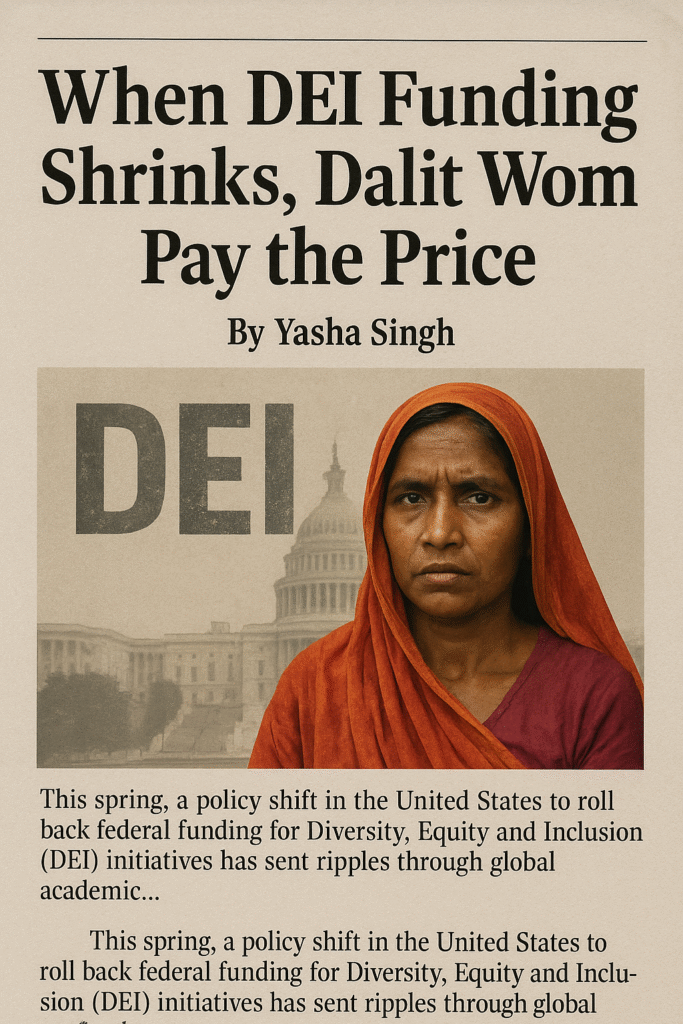
This spring, a policy shift in the United States to roll back federal funding for Diversity, Equity and Inclusion (DEI) initiatives has sent ripples through global academic and human rights communities. While the implications for race and gender equality in the U.S. have rightly drawn attention, what remains less discussed is its global impact.
As a global citizen, I write not just with concern, but with a growing sense of urgency. What may seem like a domestic policy shift in the United States reverberates across oceans, touching the lives of 1.4 billion people in my country, where caste injustice remains a brutal everyday reality. I speak of India’s Dalits – who have been historically silenced and systemically excluded and whose struggles mirror that of Black Americans. They are, in many ways, the unseen siblings of global civil rights movements.
Institutions like Harvard University had taken a lead in bringing the issue of caste equity on global stage .For many of us in India, it felt like the winds of change were beginning to stir. But the rollback of DEI support now threatens to dim our hope , stalling a momentum that had only just begun to reach our shores.
What we need to understand here is that caste is not just a relic of Indian society. It is a global apartheid that persists in invisible forms in employment, education, housing, and even technology. Like race, caste operates through social segregation and inherited disadvantage. And like racism, its heaviest burden falls on women specifically Dalit women, who live at the intersection of caste-based discrimination and patriarchal control. Therefore by taking up the issue of Dalit Atrocity , Harvard University had been doing a service to humanity . So when DEI programs are cut or deprioritized, it is often the most intersectional, least visible communities like Dalits who suffer first. Conversations about caste which are already considered “too niche” or “too local” in many Western circles are likely to be the first casualties. The funding that supports research on caste and gender, that brings Dalit women scholars and activists into global dialogues, that trains institutions to recognize caste dynamics in admissions, hiring and policymaking – that is what’s at stake. Institutions like Harvard have been instrumental in naming and addressing Caste Atrocity . In recent years, they have hosted caste-awareness conferences, expanded curriculum offerings, and fostered inclusive spaces for South Asian students from marginalized backgrounds. Harvard’s stance has also inspired other universities and city governments across the U.S. to begin recognizing caste as a protected category under non-discrimination policies. But these efforts require sustained resources and political will.
In India, Dalit women remain drastically underrepresented in public leadership, routinely subjected to violence, and locked out of economic opportunity. But these inequities do not stop at India’s borders. Caste-based exclusion has followed South Asian communities into the diaspora, including in the United States. Recent lawsuits in American tech companies have revealed caste-based workplace discrimination. Surveys among Indian-American communities show that caste identity remains a source of both privilege and marginalization. Therefore when American institutions scale back their commitment to equity, the signal sent to us in the rest of the world is that justice is negotiable – that some histories matter more than others. For the millions of Dalit women fighting for dignity and recognition, this is not some distant policy question . This is a reminder that their lives are still viewed as marginal even on global platforms that profess inclusion.Therefore the loss of this policy shift is not merely academic. It is personal, generational, and political.
In a time when global movements such as #MeToo, Black Lives Matter, Dalit Lives Matter etc. have reminded us how interconnected injustice is, we cannot afford to turn inward. The social issues of caste, gender, and race have to be understood as interconnected systems of oppression. The moral arc of history may bend toward justice, but it will not do so without institutional support.
As Dr. B.R. Ambedkar, the father of India’s Constitution and a Dalit icon, warned: “Justice is not a natural order. It is a social construct that must be defended.” Today, the defence of that construct lies in our shared commitment to equity across borders .United States has historically given the moral leadership on questions of equality. It must continue to do so , not only for its own citizens, but also for all those who look up to its institutions for inspiration and solidarity. We cannot allow the walls of inclusion to shrink at a moment when they must expand.
