When Caste Pride Slays Young Love: A Global Human Rights Crisis-
By Yasha Singh
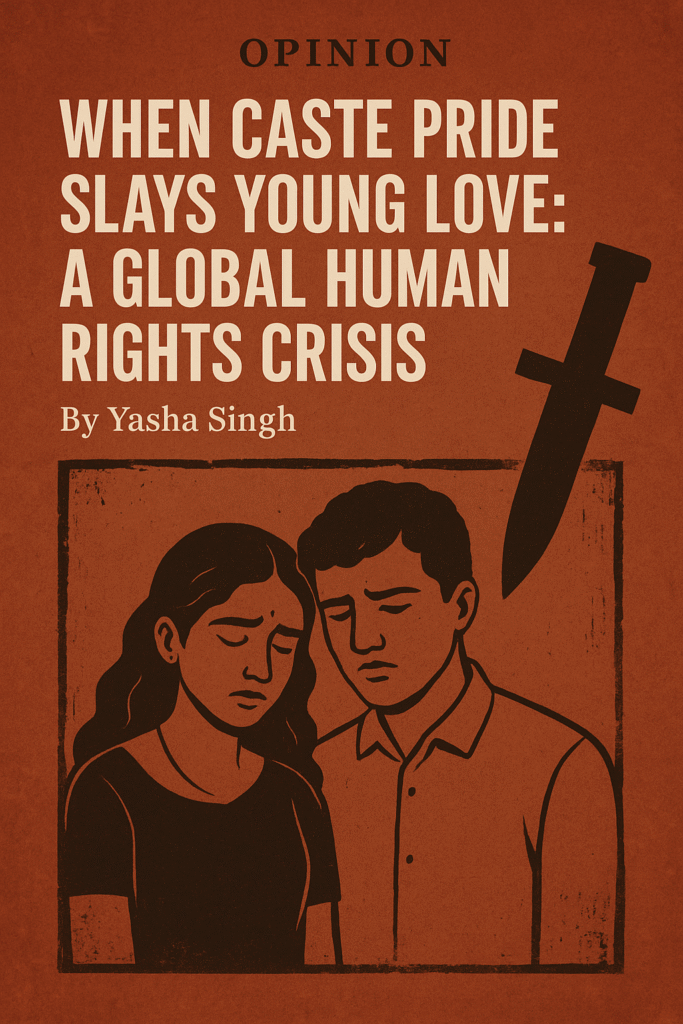
On 27th July 2025 , a Dalit software engineer, Kevin Selvaganesh, was brutally murdered in Tamil Nadu, India, for falling in love. The alleged perpetrators? His partner’s family including her own brother, a police inspector. Kevin’s crime, in the eyes of his killers, was not theft or violence but love across caste lines. Framed as an “honour killing,” his death lays bare the violent entrenchment of caste pride that continues to override constitutional rights in India.
The caste system is often narrated as a uniquely South Asian phenomenon. Yet its hereditary status, purity- pollution, and social exclusion has followed the diaspora across continents. From Indian immigrant communities in the U.S. and U.K. to caste–based hiring discrimination in Silicon Valley and visa marriages in Canada, caste has travelled and adapted.
In 2020, the California Department of Fair Employment and Housing filed a lawsuit against Cisco for caste discrimination against a Dalit engineer echoing Kevin’s story in a new economic arena. Around that same year, Harvard, Brown, and Brandeis universities began recognizing caste as a protected category.
Dr. B.R. Ambedkar once described caste as “graded inequality.” It mirrors racism in its systemic denial of dignity, autonomy, and freedom. The policing of Dalit love, especially when it crosses caste or class boundaries, is not unlike anti-miscegenation violence once seen in the Jim Crow-era American South. The notion that social groups must not “mix” is enforced through intimate, often familial, violence. Kevin’s death is akin to lynchings where Black men were murdered for perceived transgressions against white women.
This shared history has led to growing Afro–Dalit solidarities. Activists like Suraj Yengde of Harvard University have documented how Dalits and African Americans can form coalitions against casteism and racism -both of which rely on dehumanization and patriarchal control of women’s sexuality and men’s social mobility.
The framing of “honour” killings as cultural practices is misleading and dangerous. It pathologizes communities while ignoring the systemic nature of such violence. These killings are targeted attacks on human agency, especially of those at the margins: Dalits, women, LGBTQ+ individuals. Caste pride, in this sense, becomes a moral alibi for social control.
While caste is often portrayed as a uniquely South Asian issue, the logic of “honour” killings resonates globally. Similar violence occurs in contexts where families suppress inter-religious, inter-ethnic or same-sex unions. The underlying violation is the same: extinguishing individual autonomy in the name of collective reputation. International human rights law recognizes this pattern. Therefore even honour-based violence should be considered a hate crime, and it should be recognised that the enforced interference in consensual relationships is a denial of sexual and personal freedom.
For Kevin, the institutions that should have protected him failed. The alleged participation of a police officer in the murder is a grim reminder that caste pride is often shielded by impunity. Justice became hostage to bloodline. But Kevin’s story is not isolated; around the world, romantic and marital violence driven by notions of honour, caste, community, or religion continues unchecked. Therefore , Kevin’s case, and others like it, demand greater recognition of the right to love and choose without fear. The UN Human Rights Committee and Covenant on Civil and Political Rights (ICCPR) affirm that protections must extend to intimate and marital life. Forced separation, removal of choice, or victimisation on caste grounds breaches these guarantees.
Global human rights actors therefore must include caste-based hate crimes in broader “honour crime” discourse ensuring policies account for caste as a protected category. Non-governmental organizations, academic institutions, and rights-based bodies should use international human rights platforms to spotlight caste killings as a systematic violation of human dignity and equality.
Kevin’s death is a chilling reminder that caste pride is not benign tradition . It is a lethal assertion of hierarchy. Such killings deny basic human rights: freedom, equality, autonomy, and the right to love safely. Recognizing caste based honour crimes as hate crimes under both Indian and international law is a crucial step. Cultural resistance and legal reform must intersect to protect individual choice and dismantle entrenched prejudice.Silences must end on this portable hierarchy. Love must not cost lives.