
Authors-Yasha Singh and Nitin Ranjan
1. The Visibility Crisis: India’s Democratic Blind Spot
How can a democracy claim to deliver justice without knowing who its people truly are?

India’s decision in 2025 to include caste enumeration in the national census—after a gap of 94 years—is not merely a statistical exercise. It is a reckoning. For decades, the Indian state has operated without accurate data on the very communities it claims to uplift. This deliberate invisibilization of caste—particularly of Other Backward Classes (OBCs), Denotified Tribes, and sub-castes within Scheduled Castes—represents one of the gravest policy failures in the history of Indian democracy.
Despite constitutional commitments to equality, affirmative action, and social justice, India has relied on 1931 colonial-era caste estimates to allocate reservations and frame welfare policy. This failure to generate and act upon contemporary caste data has led to deep misalignments between need and policy, eroding the promise of an egalitarian republic.
While India’s Constitution formally abolished caste-based discrimination in 1950, caste continues to dictate who gets access to education, employment, and public power. Without data, these inequalities are easier to ignore. As political scientist Yogendra Yadav warns, “[The] refusal to count caste has helped preserve upper-caste dominance under the cloak of castelessness.”
The consequences of this blindness are everywhere: university faculty remain 85% upper-caste even in public institutions with OBC quotas; in Bihar, Extremely Backward Castes (EBCs) form 36% of the population but hold less than 1% of government jobs; and over 10 crore Denotified and Nomadic Tribes remain excluded from most welfare schemes due to classification gaps.
To pretend caste is no longer relevant is to close one’s eyes to its daily manifestations—and to deny data is to deny justice.
2. The Data Desert: How Policy Operated Blindfolded
India’s caste census crisis is not just a bureaucratic lapse—it is a foundational flaw in the way policy has been crafted for over seven decades. Since independence, the Indian state has maintained detailed demographic data on Scheduled Castes (SCs) and Scheduled Tribes (STs), but has completely neglected reliable enumeration of Other Backward Classes (OBCs)—a group estimated to make up over 50% of the population. The last time comprehensive caste data was collected was in the 1931 British census—nearly a century ago.
The consequences have been profound. Policies meant to uplift the socially and educationally backward have been based on approximations, not evidence. In landmark cases such as Indra Sawhney v. Union of India (1992), the Supreme Court upheld OBC reservations but imposed a 50% cap on total reservations due to the lack of reliable data. More recently, in Jaishri Laxmanrao Patil v. Chief Minister, Maharashtra (2021), the Court struck down the Maratha reservation law, again citing the absence of updated empirical caste data as a key reason.
An attempt to bridge this data vacuum through the 2011 Socio-Economic and Caste Census (SECC) ended in failure. The open-ended caste identification process produced over 46 lakh distinct caste names and 8 crore data errors, which rendered the dataset unusable. Despite government claims of near-total coverage, the Supreme Court refused to admit the SECC findings as reliable, calling the dataset “flawed and bound to mislead.”

In the absence of credible data, India’s largest social justice interventions are flying blind. Welfare schemes are misdirected. Political debates on reservation are reduced to speculation. And most importantly, millions of communities are made statistically invisible—excluded not just from opportunity, but from recognition.
As policy expert Poonam Muttreja aptly puts it: “We are designing policies in the dark while claiming to pursue social justice.”
3. Numbers Don’t Lie: What State-Level Surveys Reveal
In the absence of a national caste census, a few Indian states have taken it upon themselves to collect their own data—and the results have shattered long-held assumptions.
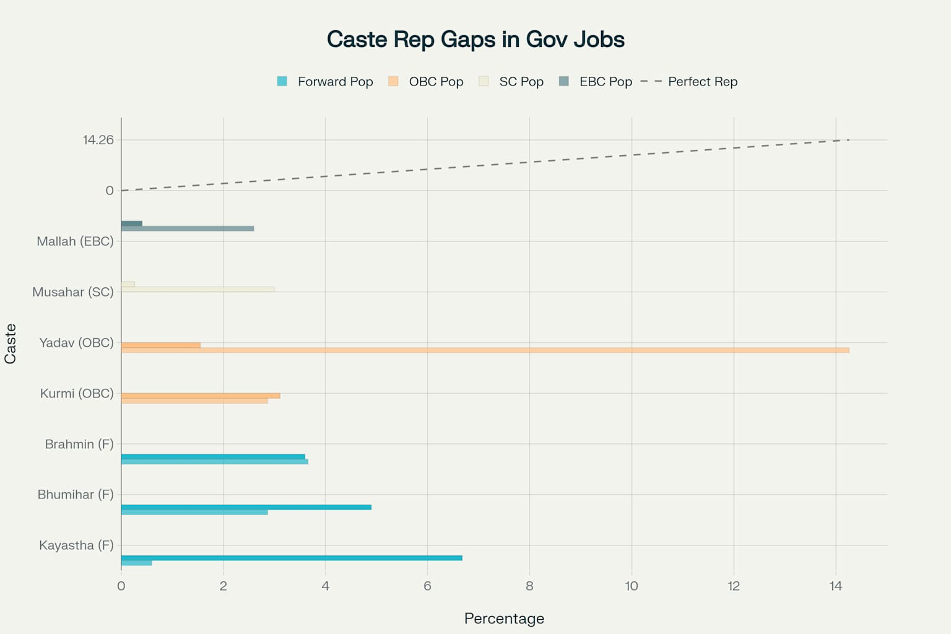
Take Bihar’s 2023 caste survey, which offers one of the most detailed pictures of caste demographics and representation in independent India. The survey revealed that OBCs and Extremely Backward Classes (EBCs) together comprise 63% of Bihar’s population, while Scheduled Castes account for another 19.65%. In stark contrast, Forward Castes—Brahmins, Kayasthas, Bhumihars, and Rajputs—constitute just 15.52% of the population.
Yet despite being a numerical minority, these upper castes enjoy a grossly disproportionate share of government jobs and economic power:
- Kayasthas, who make up just 0.6% of Bihar’s population, occupy 6.68% of government jobs.
- Bhumihars, at 2.87%, hold 4.9% of public jobs.
- In contrast, EBCs, who make up 36%, are represented in only 0.98% of government employment.
- Scheduled Castes like Musahars, make up 3% of the population but hold just 0.26% of jobs.
These numbers lay bare a brutal truth: India’s power structures remain deeply skewed along caste lines, even 75 years after independence. This overrepresentation is not limited to Bihar. A 2019 report revealed that 85% of faculty positions in India’s 45 central universities were held by upper-caste individuals, despite constitutional reservations for OBCs, SCs, and STs.
The caste survey data demolishes the argument that caste-based discrimination is a thing of the past. It is not. It is just no longer counted.
4. The Hollow Core of OBC Reservations
At the heart of India’s affirmative action framework lies a disturbing paradox: even where reservations exist, they often fail to benefit those most in need. Nowhere is this more apparent than in the case of Other Backward Classes (OBCs), where a small elite subset has captured nearly the entire pool of benefits—leaving hundreds of communities behind.
The Rohini Commission analyzed over 1.3 lakh central government jobs and educational admissions. Its findings were stark:
97% of OBC reservation benefits go to just 25% of OBC castes.
983 communities—37% of all OBC groups—have received zero representation.
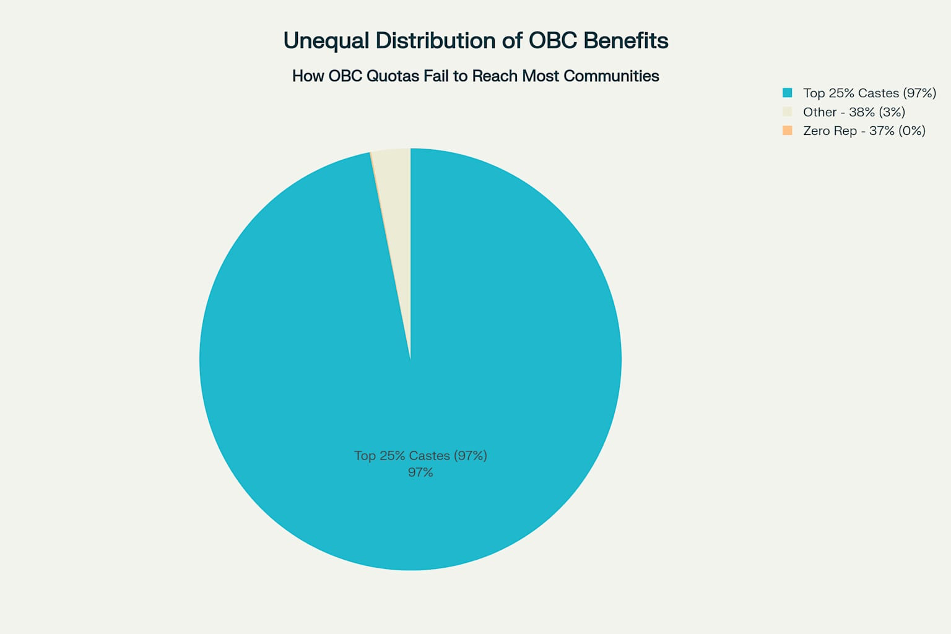
This reflects a structural failure, where dominant backward castes such as Yadavs, Kurmis, and Koeris monopolize access to opportunities. In contrast, smaller and more disadvantaged OBC communities remain locked out.
The Bihar caste survey corroborates this. Yadavs make up 14.26% of the population but account for only 1.55% of government jobs.
This internal colonization undermines the moral foundation of India’s reservation system. Without disaggregated data, such reforms are impossible.
5. The Forgotten Millions: Denotified & Nomadic Tribes
Among India’s most excluded citizens are the Denotified, Nomadic, and Semi-Nomadic Tribes (DNTs)—an estimated 10.74 crore people.
Branded as criminals under the Criminal Tribes Act of 1871, they continue to face stigma and police surveillance. Of 1,262 known DNT communities, only 179 could be recommended for classification by the Anthropological Survey of India, while 63 were “not traceable.”
Most DNTs lack caste certificates, ration cards, voter IDs, or land titles. Their exclusion from SC/ST/OBC lists locks them out of education, healthcare, and jobs. As expert committees have warned, justice for these groups begins with being counted.
6. Triple Invisibility: Dalit Women, Trans Persons, and Intersectionality
Caste intersects with gender, class, and identity to create compound layers of discrimination. Dalit women face some of the highest rates of violence—10 Dalit women and girls are raped daily, according to NCRB data.
The violence is structural, used to control women’s mobility and enforce caste hierarchy. Dalit transgender individuals, like activist Grace Banu, report exclusion from both upper-caste queer communities and cisgender Dalit communities—what she terms “cis-Brahmanical patriarchy.”
Even within SCs, disparities persist. Musahars, for instance, make up 3% of Bihar’s population but occupy only 0.26% of government jobs. A meaningful caste census must include intersectional identities and sub-categorization.
7. The Political Economy of Silence
The refusal to count caste is political. Upper-caste elites, dominant in bureaucracy, academia, and private enterprise, resist enumeration under claims of “merit” and “unity.”
Policies like lateral entry allow upper-caste professionals into civil services without reservation—bypassing constitutional safeguards. Faisal Devji describes this as a “new division of power”: Brahmins and Banias dominate the private sector, while marginalized castes compete for limited public sector roles.
Data is suppressed to preserve privilege. As Dr. Suraj Yengde warns, invisibility is a tool of domination.
8. Why Data is Power: Lessons from Global Racial Justice Movements
The U.S. offers a striking contrast. Racial data collection has enabled major policy reforms in housing, education, and criminal justice. Isabel Wilkerson draws parallels between U.S. race hierarchies and Indian caste, noting that America counts—India does not.
Resistance to caste enumeration mirrors white backlash to racial data in the U.S., rooted in fear of losing dominance. Dr. Martin Luther King Jr. observed that progress for the oppressed often triggers backlash from the privileged. Without caste data, India attempts to address injustice without knowing its scale.
9. Conclusion: A New Social Contract
India’s caste census is not just about numbers—it is about recognition, justice, and democratic renewal.
If conducted with integrity, it can expose inequality and remake policies. But the real test is what follows: Will India recognize Denotified Tribes? Reform OBC reservations? Acknowledge intersectional discrimination?
As Ambedkar said, “You cannot build anything on the foundations of caste. You have to demolish it.” That demolition must begin with truth—and truth begins with data.
This op-ed draws from a comprehensive research report published by Inside Jharkhand. The full report, titled Caste Census: A Detailed Report by Nitin Ranjan and Yasha Singh, is available for download here. This document is shared for public awareness and academic engagement only. Unauthorized reproduction, redistribution, or commercial use of any part of the report without prior written consent from the author is strictly prohibited. All rights reserved.
References
- Yogendra Yadav, “Ten Half-Truths About Caste Census,” Indian Express. https://indianexpress.com/article/opinion/columns/yogendra-yadav-writes-ten-half-truths-about-caste-census-9546946/
- AP News, “India caste census 2025 decision.” https://apnews.com/article/india-caste-census-modi-08ffeef4d1fb6bc3b4159495c6124851
- Policy Circle, “India Caste Census 2027: Why we need it.” https://www.policycircle.org/opinion/india-caste-census-2027/
- LiveLaw, “Caste Census: SECC 2011 order history.” https://www.livelaw.in/top-stories/caste-census-a-look-back-at-supreme-courts-2021-order-declining-to-direct-disclosure-of-2011-secc-report-290941
- The Wire, “How a Caste Census Can Lead Us Toward a Casteless India.” https://m.thewire.in/article/caste/how-a-caste-census-can-lead-us-towards-a-casteless-india
- Byju’s IAS, “Rohini Commission Overview.” https://byjus.com/current-affairs/rohini-commission/
- Drishti IAS, “Denotified, Nomadic, Semi-Nomadic Tribes.” https://www.drishtiias.com/daily-updates/daily-news-analysis/denotified-nomadic-semi-nomadic-tribes
- Compass RauIAS, “Impact of Classifying Denotified Tribes.” https://compass.rauias.com/current-affairs/impact-classifying-denotified-tribes/
- Equality Now, “Dalit Women Speak Out.” https://equalitynow.org/news_and_insights/dalit_women_speak_out_india/
- CLPR, “Intersectionality and Caste Report.” https://clpr.org.in/wp-content/uploads/2019/08/Intersectionality-A-Report-on-Discrimination-based-on-Caste-with-the-intersections-of-Sex-Gender-Identity-and-Disability-in-Karnataka-Andhra-Pradesh-Tamil-Nadu-and-Kerala.pdf
- Isabel Wilkerson, Caste: The Origins of Our Discontents. Penguin Random House.
- Erika Lee, America for Americans: A History of Xenophobia in the United States. Basic Books.
- Martin Luther King Jr., Where Do We Go from Here: Chaos or Community?. Beacon Press.
- Ambedkar, B.R., “You cannot build anything on the foundation of caste.” https://www.mkgandhi.org/articles/ambedkar.htm
- PIB Press Release on DNT Welfare: https://www.pib.gov.in/PressReleasePage.aspx?PRID=1796873
- India Today, “Bihar Caste Survey Report.” https://www.indiatoday.in/india/story/bihar-caste-survey-numbers-out-most-backward-classes-population-2443291-2023-10-02
- The Wire, “Unreserved: Central University Faculty Dominance.” https://thewire.in/caste/unreserved-upper-caste-central-university-faculty-ugc
- LinkedIn, V.R. Varma, “Lateral Entry Scheme Critique.” https://www.linkedin.com/pulse/lateral-entry-scheme-modi-government-failed-reform-varma-ex-ias-vr-lq3zc
© 2025 Inside Jharkhand. All rights reserved.
This article is the intellectual property of Inside Jharkhand and the author. No part of this publication may be reproduced, distributed, or transmitted in any form without prior written permission, except for brief quotations used in reviews or scholarly work with proper attribution.
