
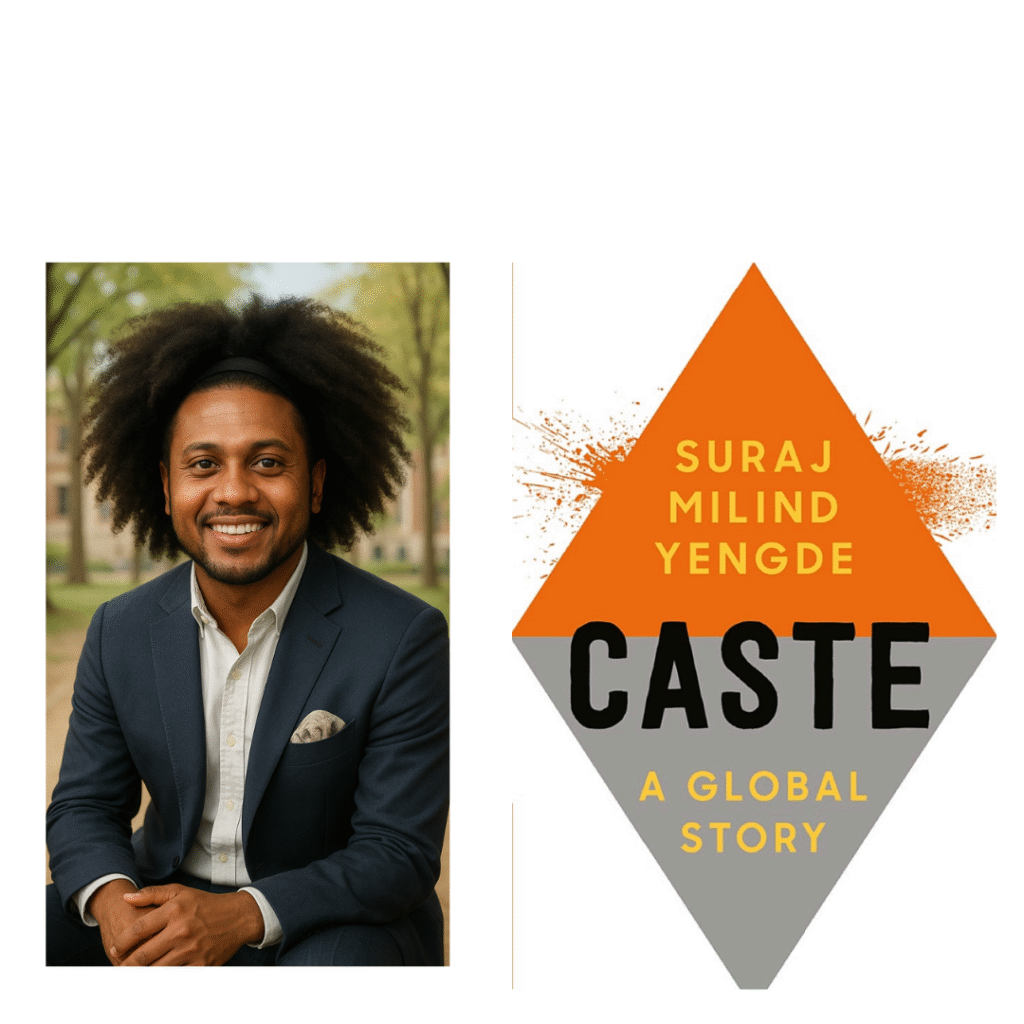
Introduction: When Rage Meets Facts
Suraj Yengde’s Caste Matters is not just a book-it is a reckoning. Rooted in personal anguish and political defiance, the text operates as a radical reorientation of how caste is understood, resisted, and narrated. Yengde refuses the comforts of liberal multiculturalism and elite scholarship. He writes not to explain caste but to expose its everyday tyranny through a lens sharpened by rage, sharpened further by method.
As someone engaged in caste justice work on the ground through initiatives like Inside Jharkhand, which documents the lived realities and institutional neglect of Dalit communities , our approach Caste Matters not as an abstract treatise, but as an epistemic companion. Yengde’s anchoring in Charvaka rationalism, in which knowledge flows from lived experience rather than scriptural or statistical authority, directly resonates with the bottom-up methodologies we use in our work: ward-level caste mapping, Panchayat role audits, and counter-enumeration against state invisibilization.
This review does not attempt a neutral summary. Instead, it enters into dialogue with the book-affirming its provocations, extending its arguments, and critically testing them against the realities uncovered through data-driven activism in caste-oppressed geographies. Where Yengde offers testimony as resistance, we bring numbers as insurgency-both confronting a nation that still denies caste even as it thrives on it.
Charvaka Epistemology vs. Brahminical Data Logic
At the heart of Caste Matters lies a radical epistemic claim: that experience-lived, embodied, unmediated-is knowledge. In reviving the Charvaka tradition, Suraj Yengde resists Brahminical modes of knowing that prioritize scripture, abstraction, and elite validation. He insists that theory must emerge from the street, not the seminar room ; from the polluted well, not the well-appointed panel.
This methodological stance is not merely philosophical; it is profoundly political. It delegitimizes the monopoly of Savarna academics and technocrats over what counts as truth. Yengde’s use of autobiography, field notes, and affect disrupts the conventions of caste scholarship, refusing the expectation that Dalit voices must perform objectivity to be taken seriously. In doing so, he not only critiques caste, but also the epistemology of caste scholarship itself.
This resonates powerfully with our work at Inside Jharkhand, where we use bottom-up data practices to subvert the state’s caste blindness. In our Counting Power report, we found that despite Panchayati Raj reservations, Dalit representation in decision-making positions remains functionally hollow. Through ward-wise enumeration and positional audits, we showed that Scheduled Caste members may be elected, but real power – file clearance, fund allocation, personnel control remains firmly in Savarna hands. The state’s official data, often celebrated as neutral, becomes a tool of erasure when it refuses to count caste where it matters most.
This is where Yengde’s Charvaka-inspired testimonial rage and our statistical insurgency converge: both insist that caste must be felt and counted, mapped not just on census sheets but in every institutional crevice. Where the state uses data to suppress experience, we deploy data to amplify it. Together, we reject the false binary between affect and analysis, between narrative and number.
In a policy ecosystem obsessed with “evidence-based governance,” Yengde reminds us that whose evidence counts and who gets to count-remains a caste question. Charvaka logic demands that we invert the pyramid: let the marginalized theorize, let the data reflect disruption, not just demographics.
Caste in the Diaspora: Invisibility and Global Echoes
In Caste Matters, Yengde disrupts the myth that caste is an “Indian problem” contained within subcontinental borders. His chapter on caste in the diaspora, especially the Caribbean and U.S.-lays bare how ritual privilege, purity logics, and social hierarchies persist even when caste is rendered unspeakable. Through encounters with Indo-Caribbean Brahmins and caste-denying Hindu nationalists in America, he exposes how caste adapts, survives, and often flourishes in new geographies under the cloak of “cultural identity” or “community service.”
Yengde’s meeting with Ravi-a self-proclaimed caste-invisibilist aligned with the RSS unmasks a deeper hypocrisy: the denial of caste by those who continue to benefit from it. Ravi believes caste no longer exists, yet describes being excluded by upper-caste Brahmins from rituals and leadership circles. This paradox is telling. In diaspora, caste is not dismantled; it is ritually coded, institutionally protected, and epistemically erased.
This resonates with what our organization Inside Jharkhand reveals about caste’s invisibilization in state institutions back home. Just as diaspora elites conceal caste behind language of merit and tradition, Indian bureaucracies often suppress caste data in the name of efficiency or neutrality. For example, our work India’s Caste Census: Data for a Just Republic report shows how ward level caste identification is frequently misclassified, omitted, or misused, especially in dominant caste pockets. The goal, in both cases, is the same: to obscure advantage, protect hierarchy, and deny discrimination without dismantling it.
Yengde is especially sharp in noting that many diaspora Hindu communities trace their lineage to non-upper castes who were indentured laborers, and yet it is the Brahminized elite who now dominate temples, associations, and discourse spaces abroad. The displacement of anti-caste resistance in these contexts echoes the silencing of Ambedkarite politics in parts of rural Jharkhand, where Dominant Caste gatekeeping has hollowed out Dalit representation in local power structures despite formal quotas.
If Yengde shows us how caste migrates with privilege, then our work in Jharkhand documents how it mutates within the bureaucratic structure. Both call for transnational caste accountability-a framework that moves beyond token diversity and demands redistribution, recognition, and record-keeping wherever caste manifests.
Savarna Reform, Data Erasure, and the Limits of Inclusion
One of Caste Matters’ sharpest interventions lies in its scathing critique of what Yengde calls “Savarna-led reform”-a politics of symbolic allyship that displaces structural redistribution with sanitized inclusion. Yengde deconstructs how upper-caste liberals have positioned themselves as spokespeople for anti-caste progress while refusing to cede real power, resources, or authority. He terms these actors “Protestant Hindus” who are willing to critique caste as a social evil, but unwilling to rupture the hierarchies that sustain their dominance.
This diagnosis rings painfully true in the empirical contexts we encounter at Inside Jharkhand. Our fieldwork reveals a disturbing pattern: dominant castes co-opting the language of social justice while quietly undermining its intent. In our work , India’s Caste Census: Data for a Just Republic, we show how Block Development Officers, often from upper castes, underreport caste-based irregularities in welfare schemes, manipulate beneficiary lists, and dilute grievance redressal mechanisms. On paper, the system appears inclusive; in practice, it is built to fail the Dalit claimant.
Yengde’s argument that “inclusion without confrontation” is merely absorption finds strong echoes in these administrative realities. Even in Panchayats reserved for Scheduled Castes, as documented in our work Counting Power, decision-making is often outsourced to dominant caste “proxies,” undermining Dalit autonomy. What passes as reform is often a carefully curated theatre of representation, lacking in institutional transfer of control or epistemic revaluation.
Data plays a pivotal role in this erasure. Just as Savarna commentators selectively cite statistics to downplay caste, local bureaucrats weaponize data gaps and vagueness to delay justice. Files are “lost,” categories are blurred, and caste identities are misrecorded. These are not errors of omission; they are technologies of exclusion.
Yengde challenges this through a refusal to validate Savarna efforts that stop short of redistribution, reparations, and reversal of roles. He demands more than representation, he demands rupture. In the same spirit, our reports call not just for better inclusion, but for reparative governance: one that centers Dalit knowledge systems, funds Dalit institutions, and quantifies power alongside presence.
In both Yengde’s critique and our field observations, the message is clear: reform that does not dismantle Savarna data control, discourse dominance, and bureaucratic immunity is not anti-caste-it is caste in a softer guise.
Statecraft, Representation, and the Data Battlefield
Yengde’s confrontation with the Indian state is not limited to identity politics; it’s a broader indictment of statecraft itself as castecraft. He argues that the Indian state’s ideological core-its bureaucracy, meritocracy, and public institutions-remains deeply Brahminical, even when it performs inclusivity. He calls out the illusion of representation, where Scheduled Castes are present in statistics, but absent from power.
This illusion is systematically exposed in our work at Inside Jharkhand, particularly through the Counting Power report. Our analysis of SC-reserved Panchayats revealed that while Dalits may hold office, they are excluded from procedural authority-denied access to files, budgets, and crucial staff coordination. Their tenure becomes symbolic representation without functional sovereignty.
This mirrors Yengde’s critique of tokenism in governance. He writes that “the Dalit is seen but not heard, heard but not believed.” In the Indian state, visibility becomes a form of containment, not liberation. As our datasets show, the reservation system can be manipulated to reinscribe caste hierarchies under the guise of democratic parity. The Panchayat system becomes a stage on which Dalit leaders are paraded, but decisions are choreographed by dominant caste actors behind the scenes.
Further, our work India’s Caste Census: Data for a Just Republic reveals how data becomes a weapon-both through what is collected and what is conveniently ignored. Caste-wise data on local level asset control, government contract distribution, or staff hierarchies is non-existent. Where it exists, it is fragmented, unverifiable, or concealed under neutral categories. As Yengde suggests, the problem is not that the state lacks data-it is that the state is committed to not knowing caste, except when it serves its control.
Yengde’s call for a Dalit-led epistemology of statehood-one that challenges not just who governs but how governance is structured-is a crucial provocation. Our field experience affirms this: anti-caste data must be not just about documenting inequality, but disrupting the bureaucratic gaze itself. This means privileging community enumeration, participatory audits, and public-facing data dashboards that invert the flow of accountability.
The fight for caste justice, then, is not only fought in the courts or elections-it is fought in Excel sheets, file notings, and official forms. And it is in these silent bureaucratic trenches that both Caste Matters and Inside Jharkhand stake their most urgent claims.
Conclusion: Toward Epistemic Sovereignty and Data Justice
Caste Matters is not just a polemic against caste-it is a declaration of epistemic war. Suraj Yengde refuses the seductions of civility, inclusion, and academic objectivity. Instead, he insists on a Dalit sovereignty of thought, rooted in rage, sharpened by experience, and unapologetically confrontational. His revival of Charvaka materialism is more than a nod to heterodox philosophy-it is a demand to decolonize knowledge from Brahminical and Western custodianship alike.
As a caste justice practitioner working through Inside Jharkhand, we find Yengde’s call not only compelling but essential. Our reports, Counting Power and India’s Caste Census: Data for a Just Republic, are not merely diagnostic-they are acts of resistance against the ways statecraft erases caste while sustaining it. We count not just to inform but to expose, not just to document but to demand. We stand with Yengde in asserting that Dalit liberation requires epistemic freedom, where knowledge is not mediated through Savarna benevolence but produced, owned, and disseminated by the oppressed themselves.
The fight ahead is not only for policy change- it is for data justice, methodological reparation, and institutional inversion. It is about transforming the archive, the survey, the database, and the dashboard into instruments of caste accountability rather than tools of Brahminical control.
Yengde gives us the language of defiance. Our task now is to build the infrastructure of disruption-in the courtroom and classroom, in the Panchayat office and public discourse. His book is a mirror and a map. It reflects the violence we endure and charts a route we must take: toward epistemic sovereignty, radical counting, and a future where caste no longer matters-because it no longer exists.
